Introduction: The Myth of the Serene Genius
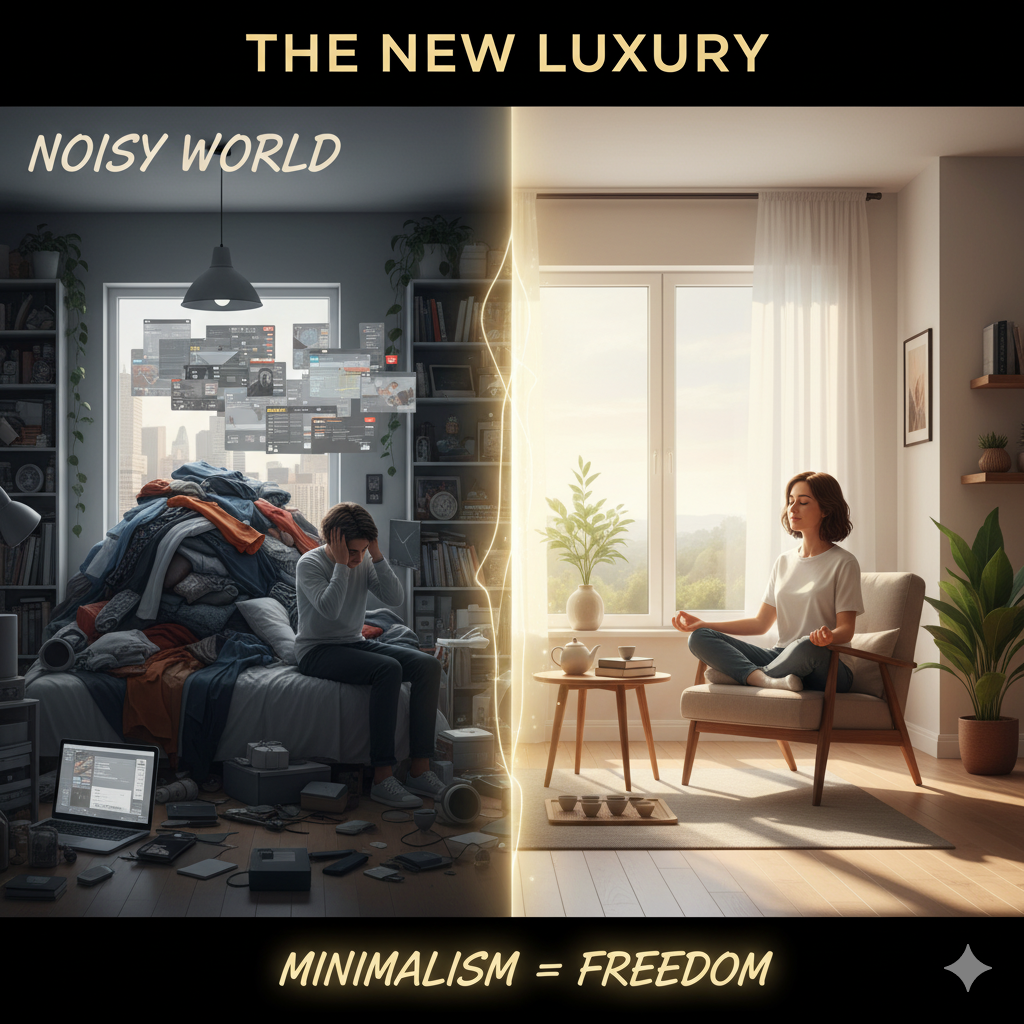
Picture the ideal creative environment: a quiet, minimalist studio, a perfectly organized desk, a fresh pot of herbal tea, and endless, stress-free time. This image of the serene genius, calmly waiting for inspiration to arrive, is the one society often sells us. We are told to declutter our minds and our spaces to achieve peak creativity.
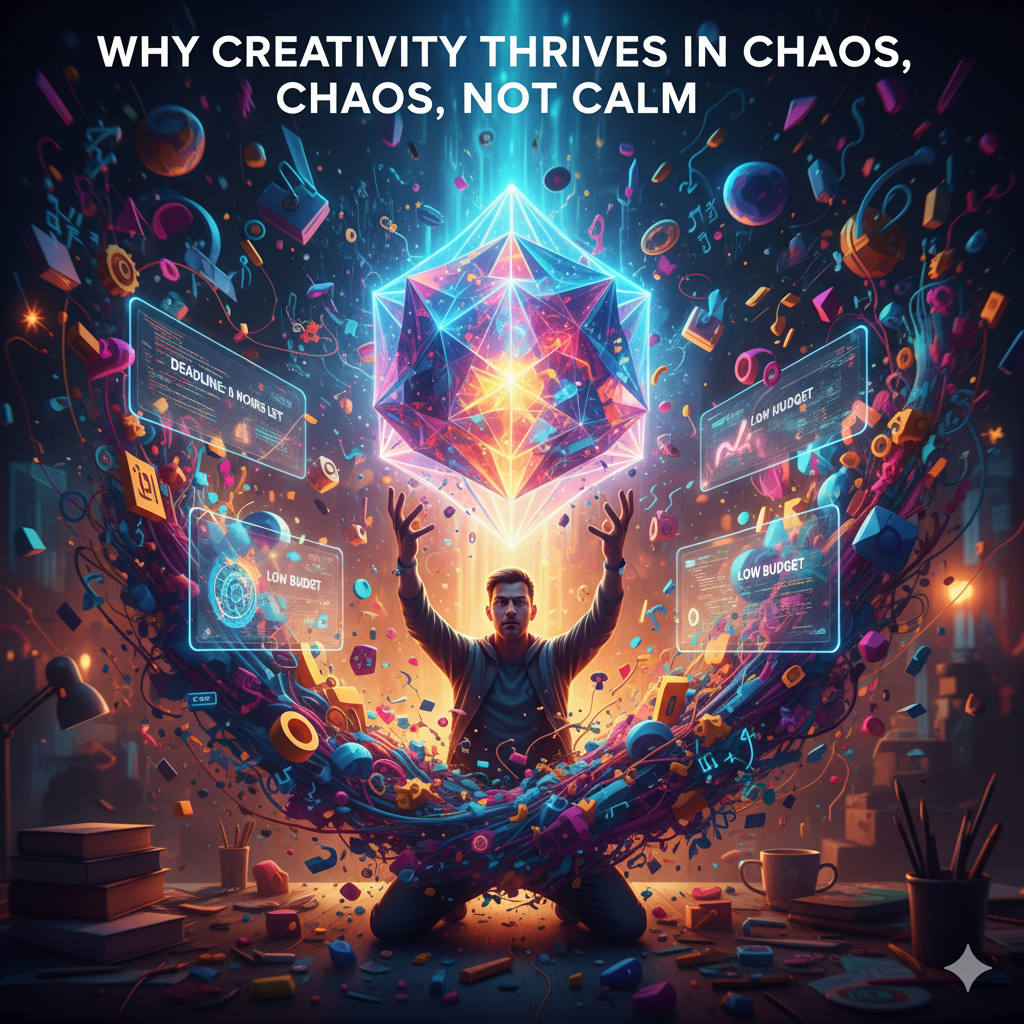
But if you look at history, art, and business, the greatest leaps forward rarely happen in a tranquil vacuum. They emerge from the pressure cooker of constraints, the urgency of a deadline, the anxiety of a crisis, or the beautiful, messy clash of ideas. Think of the intense pressure-cooker environment of the early Apple garage, the chaotic urgency of a jazz improvisation, or the rapid innovation seen during periods of global conflict.
The truth is, while routine supports maintenance, Creativity Thrives in Chaos. Chaos—defined not as total disarray, but as a state of controlled disequilibrium, tension, and constraint—is the essential catalyst for breaking cognitive patterns. Calmness often breeds contentment and fixation; chaos demands adaptation and forces the mind to forge novel connections out of necessity.
In this extensive article, we will dismantle the myth of the “calm creative,” explore the neurochemical reasons Why Creativity Thrives in Chaos, and provide a framework for embracing productive disorder to unlock your most innovative thinking.
Background and Context: The Neurochemistry of the Edge
To understand Why Creativity Thrives in Chaos, we must look past the visible mess and examine what happens in the brain when it’s pushed to the edge. The perceived state of “chaos” or pressure triggers a complex chemical response designed to enhance problem-solving, not shut it down.
The Dopamine Surge and Cognitive Flexibility
When we are under moderate pressure—the kind of stress that comes from a looming deadline or a complex, ill-defined problem—the brain releases key neurotransmitters that are direct stimulants for creativity:
- Dopamine: This isn’t just the pleasure hormone; it’s the novelty and exploration hormone. Moderate stress increases dopamine levels, which in turn enhances cognitive flexibility. Dopamine helps reduce latent inhibition, making the brain less likely to filter out seemingly irrelevant or distracting information. This allows the creative mind to connect remote, disparate concepts that a calm, ordered mind would dismiss as noise.
- Noradrenaline (Norepinephrine): This stress hormone, released during times of urgency, acts as a focusing agent. While high levels lead to panic, moderate levels narrow the attentional field just enough to cut out unnecessary fluff, forcing the brain to focus its energy on the core problem at hand. The chaotic pressure converts effort into an intense, directed flow state.
Cognitive Disinhibition: The Key to Novelty
The most critical factor in the brain’s response to chaos is cognitive disinhibition, or the filtering mechanism relaxing its grip.
In a state of calm, your brain works on efficiency: it uses established pathways to solve problems (cognitive fixation). It prefers the known and the easy. When faced with chaos—a resource constraint, a time limit, or a sudden, unexpected change—the brain’s filters momentarily break down. This “disinhibition” allows traditionally filtered-out, obscure, and tangential ideas to bubble up to conscious awareness.
This is the very essence of the “Aha!” moment. It’s not a new idea appearing from nowhere; it’s the chaotic environment forcing the brain to acknowledge and combine existing but previously ignored ideas. The chaotic environment of the modern world, with its information overload and constant change, continuously forces this disinhibition, which is Why Creativity Thrives in Chaos.
The Boredom Paradox and the Default Mode Network (DMN)
Another element of “chaos” is the unstructured state that forces the mind to wander—often manifesting as boredom.
When your mind is not actively engaged in a task (i.e., you are “bored” or simply processing environmental noise), the Default Mode Network (DMN) becomes active. The DMN is responsible for self-reflection, planning the future, and, crucially, making abstract associations and synthesizing information. Constant calm and routine often involve passive consumption (like scrolling through social media) which suppresses the DMN. The pressure of unstructured time or the messy environment forces the DMN to kick in, which is the engine of original thought.
Detailed Comparison: Structure vs. Stimulus
The debate over environment often boils down to whether structure or stimulation best facilitates creative output. The evidence suggests that a controlled chaotic environment (one with rich stimuli and tight constraints) is often more potent than a purely organized one.
| Environmental Factor | The “Calm” Approach (Order) | The “Chaotic” Approach (Productive Disorder) |
|---|---|---|
| Workspace & Aesthetics | Minimalist, clean desk, quiet room, controlled color palettes. | Cluttered desk (organized chaos), visible stimulus (books, art), ambient noise (e.g., coffee shop). |
| Cognitive Outcome | Efficiency and Depth in known tasks. Prone to Cognitive Fixation (stuck on the first good idea). | Divergent Thinking and Associative Leap. Prone to Distraction but forces Novelty. |
| Time Management | Open, flexible schedules; long, uninterrupted blocks; planning for every hour. | Tight, immovable deadlines; urgent scarcity of time; forced multi-tasking and context-switching. |
| Resource Availability | Abundant access to tools, budget, and personnel—no immediate constraints. | Resource Scarcity (Constraint); forced use of existing tools in new ways (necessity is the mother of invention). |
| Neurochemical State | Low-arousal, maintenance mode (Serotonin-dominant). | Moderate Arousal (Dopamine/Noradrenaline-dominant) enhancing flexible thinking. |
| Governing Principle | Comfort and Predictability. | Tension and Adaptability. |
The key takeaway is that true Creativity Thrives in Chaos not because of the mess itself, but because the mess (or the pressure) acts as a constraint. Constraints force us to abandon comfortable, obvious solutions and explore remote possibilities.
Key Features and Benefits: How Constraint Sparks Genius
The benefits of embracing creative chaos stem from the unique pressures it places on the cognitive process, leading to breakthroughs that calm, routine environments seldom achieve.
1. The Power of Forced Association and Remote Linkages
When faced with constraints or an overwhelming amount of unstructured input (chaos), the mind cannot rely on linear thinking.
- Necessity to Bridge Gaps: If you have only two hours and five non-related resources to solve a problem, you are forced to make a remote association—a connection between two ideas that seem completely unrelated. This is the definition of true innovation. The chaotic input forces your brain to try every possible combination, dramatically increasing the chance of finding a novel, high-impact solution.
- Juxtaposition in Art: Think of Dadaism or Surrealism—artistic movements that intentionally embraced chaos and the juxtaposition of illogical elements to produce radically new meaning. This process mirrors the brain’s forced associative linking under pressure.
2. Time Scarcity and the Urgency Flow State
The deadline, the quintessential element of controlled chaos, is one of the most reliable drivers of creative output.
- The Yerkes-Dodson Law: This psychological principle suggests that performance increases with physiological or mental arousal, but only up to a point. Moderate stress (time scarcity) drives us into a state of intense, hyper-focused activity that optimizes cognitive resources, often referred to as the Urgency Flow State. This state allows Creativity Thrives in Chaos by focusing all energy on solution generation, eliminating second-guessing.
- Pre-Mortem Thinking: When a deadline is tight, we are forced to prioritize ruthlessly and make decisions with incomplete information. This “high-stakes” environment leads to better, faster risk assessment.
3. Emotional Arousal and Authenticity
Creative expression is often deeply tied to emotional states, and chaos provides a powerful emotional catalyst.
- Passion over Precision: Chaotic environments—especially collaborative ones like a hackathon or a brainstorming session with high emotional energy—prioritize immediate, authentic ideas over polished, cautious ones. This lowers the barrier to sharing unconventional concepts, which are often the seeds of genuine innovation.
- The “Burning Platform”: In business, a crisis (the ultimate chaos) often motivates radical, collaborative creativity that years of calm, incremental planning could never achieve. When the survival of the business is at stake, people naturally shed bureaucratic habits and embrace high-risk, high-reward solutions.
Pros and Cons: Weighing the Creative Tension
Embracing the principle that Creativity Thrives in Chaos is a delicate balancing act. While the benefits of constraint are high, the risks of burnout and genuine, unproductive chaos are real.
| Pros (The Rewards of Controlled Chaos) | Cons (The Risks of Unmanaged Disorder) |
|---|---|
| Accelerated Innovation: Constraints (time, budget, resources) force the rejection of easy solutions and drive radical, faster breakthroughs out of necessity. | Burnout and Fatigue: Prolonged exposure to high-stress, chaotic environments without recovery leads to chronic stress and diminished long-term creative capacity. |
| Enhanced Divergent Thinking: The brain’s filtering mechanism relaxes, allowing remote associations and seemingly irrelevant data to inform the problem-solving process. | Analysis Paralysis: Excessive information overload or lack of any defined structure can overwhelm the cognitive process, leading to inaction rather than innovation. |
| Flow State Activation: Moderate urgency, as opposed to calm, often acts as the trigger for a hyper-focused, productive flow state. | Quality Control Issues: Speed and urgency, while driving novelty, can compromise the execution, detail, and polish necessary for a high-quality final product. |
| Reduced Cognitive Fixation: Constant pressure prevents the mind from settling on the first adequate solution, pushing it to find truly optimal or novel outcomes. | Conflict and Toxicity: Unmanaged interpersonal chaos, lack of psychological safety, or excessive competition can erode trust and stifle collaborative creativity. |
| Authentic Engagement: The emotional urgency motivates deeper, more passionate investment in the problem and solution, leading to more meaningful output. | Loss of Institutional Knowledge: High turnover and frantic pace prevent documentation and knowledge transfer, making the next round of innovation harder. |
Use Cases: Where Creativity Thrives in Chaos in the Real World
The evidence that Creativity Thrives in Chaos is not limited to psychological theory; it is proven daily in some of the most innovative environments on the planet.
1. Startups and the Scrappy Phase
The archetypal startup environment is defined by chaos: limited funding, an aggressive launch timeline, a small team, and an unknown market.
- Resource Constraints as Muse: Startups rarely have the luxury of hiring a perfect specialist or buying the best tool. They are forced to “hack” existing resources, pivot constantly, and use simple, often unconventional, solutions. This constraint is the core driver of their disruptive innovation.
- The Minimum Viable Product (MVP): The rush to produce an MVP is a direct application of the urgency flow state, forcing the team to focus only on the essential, novel core of the idea.
2. The Jam Session Model (Music and Design)
In creative arts, the chaotic environment is often deliberately created and managed to force spontaneity.
- Jazz Improvisation: A jazz jam session is a perfect model of managed chaos. The musicians agree on a basic structure (key, tempo, chord progression) but within that framework, they must react instantly and unconventionally to the unexpected musical decisions of their bandmates. This high-pressure, moment-to-moment adaptation is where truly unique musical phrases are born.
- Design Sprints: Many modern design firms use short, high-intensity sprints (often 5 days) to solve massive problems. The time constraint (chaos) forces rapid prototyping, testing, and radical solution generation, bypassing the usual month-long meeting cycles.
3. Crisis Management and Innovation
Crisis is pure, unadulterated chaos, yet it is often the most fertile ground for system-changing innovation.
- The Apollo 13 Mission: Faced with a catastrophe, the engineers in Houston had to quickly invent solutions using only the limited materials available on the spacecraft. The ultimate constraint—life and death—forced a level of collective, remote-associative creativity that became legendary.
- Wartime Technologies: Historically, periods of war or pandemic accelerate innovation at an unbelievable speed (e.g., penicillin, radar, messenger RNA vaccines). The existential threat creates the ultimate pressure-cooker environment where the risk of novel ideas is suddenly deemed acceptable, proving that necessity truly is the mother of all invention.
FAQs: Understanding the Chaotic Creative Process
Navigating the intersection of disorder and ingenuity requires clarity on how to apply the principles that ensure Creativity Thrives in Chaos.
Q1: Is a messy desk a sign that Creativity Thrives in Chaos?
A messy desk can indeed be a sign of a mind processing complexity. Research by Kathleen Vohs suggests that working in a messy room makes people more likely to choose novelty over convention. The disorganization acts as a stimulus, signalling to the brain that the environment is unstructured, which encourages the exploration of non-traditional ideas. However, it’s only productive if the user knows where everything is—it must be organized chaos.
Q2: How is “chaos” different from “panic” or burnout?
Chaos, in this context, is controlled arousal—it involves moderate stress and defined constraints (a deadline, a budget) within an overall safe environment. Panic, or burnout, is high, sustained, and uncontrolled stress that triggers the amygdala, leading to cognitive shutdown (fight, flight, or freeze). The key difference is the presence of an overall sense of safety and agency within the pressure.
Q3: If Creativity Thrives in Chaos, should I deliberately procrastinate?
While some creative people procrastinate and use the last-minute deadline rush for that urgency flow state, it’s not an efficient strategy. Instead of relying on procrastination, you can create artificial constraints. Break a large project into many small, arbitrary, aggressive deadlines. This triggers the dopamine/noradrenaline response without the overwhelming anxiety of true, high-stakes procrastination.
Q4: Does this principle apply to all types of work, or just artistic pursuits?
The principle that Creativity Thrives in Chaos applies universally. In analytical fields, chaos takes the form of ill-defined problems, incomplete data sets, or paradigm-shifting challenges. It forces scientists to look outside the established hypothesis, engineers to use existing components in new ways, and financial analysts to model scenarios that defy conventional wisdom. It is the engine of systemic innovation.
Q5: How can I introduce productive Creativity Thrives in Chaos into a calm, corporate environment?
Introduce structured chaos through mechanisms like:
- Innovation Jams: Short, intense sessions with strict time limits and intentionally diverse, multidisciplinary teams.
- Resource Scarcity Challenges: Assign a project a significantly smaller budget or tighter deadline than usual, forcing novel solutions.
- Ambiguity: Give teams problems that are deliberately ill-defined and require the team to frame the question before solving it.
Q6: Can a chaotic environment improve team collaboration?
Yes, provided there is high psychological safety. When a team faces a crisis or a daunting constraint together (shared chaos), it can act as a powerful bonding agent, forcing radical transparency and shared vulnerability. This intensity dissolves pre-existing power dynamics and promotes a higher level of trust and immediate, unfiltered collaboration that a calm environment seldom mandates.
Conclusion: Embracing the Messy Middle
The evidence is clear: the most profound, original, and impactful creative work often emerges not from the idyllic vacuum of perfect calm, but from the fertile ground of controlled disorder, constraint, and cognitive tension. Why Creativity Thrives in Chaos is not a mystical concept; it’s a neurochemical reality. Chaos forces cognitive flexibility, enhances remote association, and activates the urgency flow state that bypasses our habitual, fixed thinking.
The key to harnessing this power is to understand the difference between destructive chaos (overwhelm, burnout, panic) and productive chaos (constraint, urgency, managed complexity). The former shuts the mind down; the latter forces it wide open. By intentionally seeking out and managing the constraints in our work—the tight deadline, the limited budget, the requirement to combine incompatible ideas—we stop waiting for passive inspiration and instead become active engineers of our own creative breakthroughs.
Final Verdict: Your Creative Sweet Spot
The final verdict is that your highest level of creative performance exists in a carefully managed creative sweet spot—a dynamic state situated precisely between paralyzing anxiety and complacent boredom.
Don’t chase calm; chase constraint.
To unlock your next major idea, stop seeking the noise-canceling headphones and the clean slate. Instead, deliberately introduce a manageable level of productive disorder into your process. Give yourself a ridiculous deadline. Force yourself to build a solution using only the things immediately available to you. Embrace the fact that Creativity Thrives in Chaos, because chaos is what compels you to be truly original.