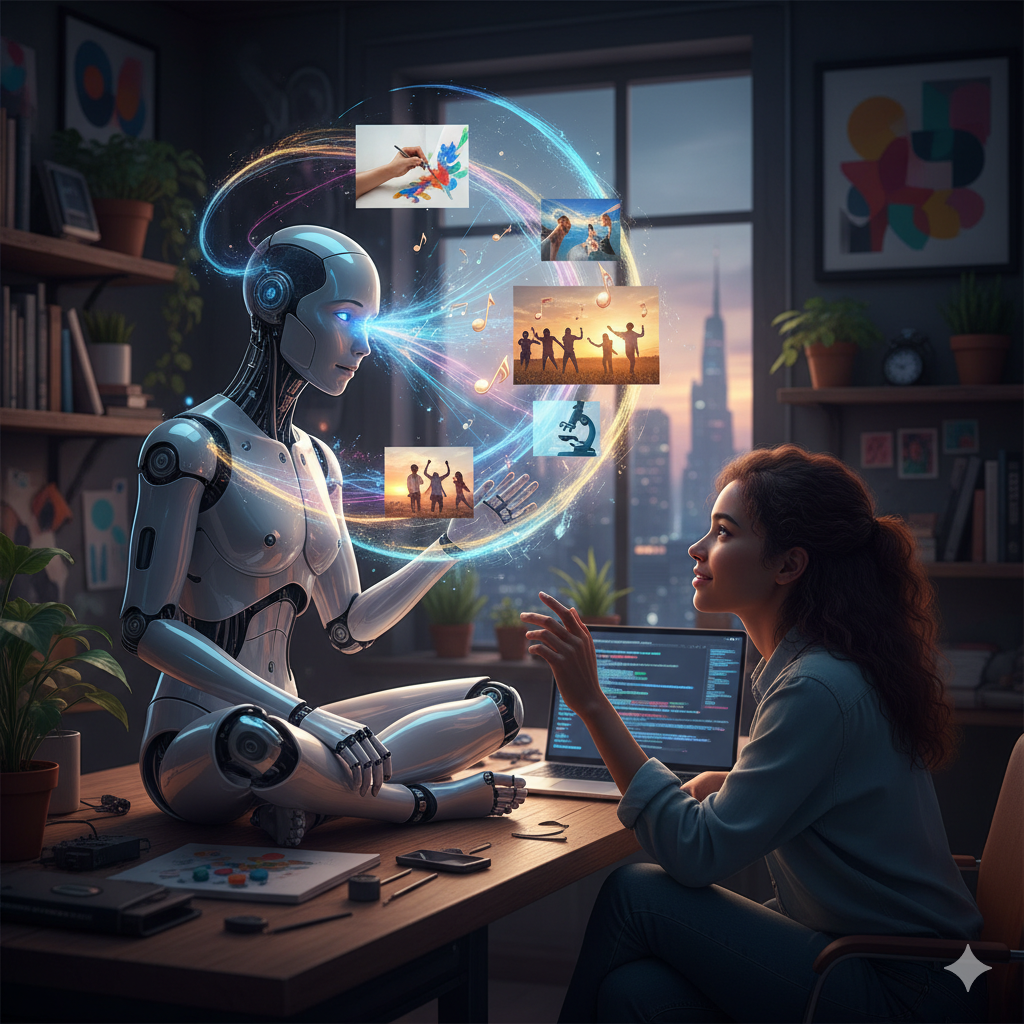
Imagine a world where your refrigerator orders milk before you run out, where cars drive themselves with uncanny precision, and where a computer can compose a symphony that touches your soul. This isn’t the distant future; it’s the rapidly evolving present, powered by Artificial Intelligence (AI). Yet, amidst the awe-inspiring algorithms and the staggering processing power, a critical question often gets lost: What about us? What about the human side of Artificial Intelligence?
AI is more than just code; it’s a mirror reflecting our own intelligence, biases, and creativity. This article is not a deep dive into neural networks or backpropagation; it’s an exploration of the symbiotic relationship between human potential and machine capability. We will journey through the history, ethics, and tangible benefits of AI, always keeping a keen eye on how this technology is fundamentally reshaping what it means to be human in the 21st century. Prepare to move beyond the fear of the ‘robot takeover’ and discover a partnership that is more about augmentation than replacement.
<h2>Background and Context: From Logical Machines to Creative Partners</h2>
The concept of intelligent machines dates back to Greek mythology, but the formal field of AI was christened at the 1956 Dartmouth workshop. For decades, it was a cycle of “AI winters” and summers—periods of intense optimism followed by funding cuts and disappointment. The breakthrough? It wasn’t a singular invention, but a confluence of massive data availability (Big Data), exponentially increasing computing power (Moore’s Law), and the refinement of neural network models (Deep Learning).
The current era is defined by Narrow AI, systems designed to perform specific tasks (like Siri, Google Search, or Netflix recommendations). The looming goal is General AI (AGI), a machine with the ability to understand, learn, and apply its intelligence to solve any problem a human being can.
<h3>The Historical Trajectory of Artificial Intelligence</h3>
- 1950s: The Turing Test proposed. Initial concepts of “thinking machines.”
- 1970s: First AI Winter. Limitations in computing power and data became apparent.
- 1980s: Expert Systems emerge, bringing AI into commercial use.
- 2010s-Present: Deep Learning Revolution. GPUs, massive datasets, and new algorithms (like Generative Adversarial Networks – GANs) unlock unprecedented performance in image recognition, language processing, and creative generation.
This journey highlights a transition. Early AI sought to mimic human logic. Modern AI, however, is increasingly focused on augmenting human intuition and creativity. This is the core of the human side of Artificial Intelligence—using machine precision to amplify human experience.
<h2>Detailed Comparison: Augmentation vs. Automation – The Human/AI Synergy</h2>
The biggest misconception about AI is that it only exists to replace human jobs. A more accurate view is one of synergy: AI excels at tasks that are repetitive, data-intensive, and prone to human error, while humans provide context, creativity, emotional intelligence, and complex problem-solving. This table illustrates the fundamental differences and the power of their collaboration.
| Feature | Automation (Machine’s Strength) | Augmentation (Human’s Strength + Machine Aid) |
| Core Function | Repetition, Pattern Recognition, Data Processing | Strategy, Ideation, Ethical Judgment |
| Pace | Lightning Fast | Deliberate, Reflective |
| Error Handling | Systematic, Fails within Code/Data Limits | Adaptive, Contextual, Learns from Novel Errors |
| The “Why” | Not applicable; operates based on programming | Provides emotional, ethical, and societal context |
| Example Task | Analyzing a million chest X-rays for anomalies. | Deciding on a patient’s personalized treatment plan and communicating it with empathy. |
| The Human Side of AI | Efficiency and Scale | Meaning and Direction |
Export to Sheets
This table shows that true value comes not from letting the machine do everything, but from letting it handle the heavy lifting so humans can focus on the truly complex, uniquely human tasks. It’s about being better together.
<h2>Key Features and Benefits: How AI Elevates the Human Experience</h2>
The practical applications of AI extend far beyond the laboratory. They are woven into the fabric of daily life, offering benefits that enhance our health, knowledge, and productivity.
<h3>Personalization and Precision Medicine</h3>
AI is transforming healthcare by shifting the focus from generalized treatments to personalized care. Machine learning models can analyze genetic data, medical history, and lifestyle factors to predict disease risk with incredible accuracy. This is not just a statistical feat; it’s a deeply human benefit: early diagnosis saves lives. For instance, AI algorithms can spot cancerous nodules in mammograms years before a human radiologist might, offering a crucial head start.
<h3>Unlocking Human Creativity and Efficiency</h3>
Far from stifling creativity, AI is becoming a powerful muse. Musicians use AI to generate new melodic variations; writers use it to overcome creative blocks; and architects use generative design algorithms to explore structural possibilities no human hand could sketch. By automating the mundane, AI frees up cognitive resources for innovation and deep creative work.
<h3>Democratization of Knowledge and Access</h3>
AI-powered language models are breaking down communication barriers. Real-time translation services make global collaboration seamless. Educational platforms use AI to create adaptive learning environments, tailoring content difficulty and style to each student’s pace. This democratization of access to education and information is one of the most significant and often overlooked aspects of the human side of Artificial Intelligence.
<h2>Pros and Cons: Weighing the Scale of Progress</h2>
As with any transformative technology, AI brings a spectrum of advantages and disadvantages that must be thoughtfully addressed to ensure responsible deployment.
| Aspect | Pros (The Human Gain) | Cons (The Human Risk) |
| Productivity | Massive increases in efficiency and automation of dangerous tasks. | Job displacement in predictable, routine roles; risk of skill erosion. |
| Decision Making | Highly objective, data-driven insights; reduced human bias in structured tasks. | Algorithmic bias (if trained on biased data); lack of transparency (“black box” problem). |
| Quality of Life | Precision healthcare, personalized services, more leisure time (in theory). | Privacy concerns (constant data collection); potential for manipulation (deepfakes, targeted misinformation). |
| Innovation | Accelerates scientific discovery and creative exploration. | Potential for misuse (autonomous weapons); concentration of power in a few tech giants. |
Export to Sheets
The key takeaway is that the ‘Cons’ are largely human problems reflected in the technology—bias, greed, and lack of foresight. Addressing these requires robust ethical frameworks, not a halt on innovation.
<h2>Use Cases and Who Should Embrace AI</h2>
AI is no longer a tool reserved for Silicon Valley giants; it’s a foundational technology that offers value across every sector.
- Healthcare Professionals: For diagnosing images (radiology), managing patient data, and drug discovery.
- Small Business Owners: For automating customer service (chatbots), personalized marketing, and inventory forecasting.
- Creatives (Writers, Designers, Artists): For overcoming creative blocks, generating initial drafts, and scaling production.
- Educators and Students: For personalized learning paths, automated grading, and research assistance.
- Environmental Scientists: For climate modeling, tracking deforestation, and optimizing renewable energy grids.
Essentially, anyone who deals with large volumes of data, seeks to enhance efficiency, or aims to solve complex, repetitive problems should be integrating AI tools. The competitive edge tomorrow will not belong to those who use AI, but to those who skillfully integrate the human side of Artificial Intelligence with the machine’s power.
<h2>Frequently Asked Questions (FAQs) about the Human Side of Artificial Intelligence</h2>
<h3>Q1: Will AI Take All Our Jobs, and What Can Humans Do to Prepare?</h3>
A: AI will automate tasks, not entire jobs. The focus will shift from repetitive execution to uniquely human skills: creativity, critical thinking, empathy, and complex collaboration. Preparing involves ‘upskilling’ in emotional intelligence and learning to work alongside AI tools (AI literacy).
<h3>Q2: How Can We Ensure AI Systems Are Not Biased?</h3>
A: Algorithmic bias stems from biased data, which is a reflection of historical human biases. The solution requires diverse teams building the AI, meticulous auditing of training data, and developing ‘explainable AI’ (XAI) to understand why a system made a certain decision.
<h3>Q3: What Role Does Ethics Play in Developing Artificial Intelligence?</h3>
A: Ethics is arguably the most crucial component of the human side of Artificial Intelligence. It ensures systems are fair, transparent, accountable, and designed to benefit humanity. This includes establishing ethical guidelines for data privacy, algorithmic autonomy, and societal impact before deployment.
<h3>Q4: Is it Possible for AI to Become Conscious or Feel Emotions?</h3>
A: Current AI systems are built on complex pattern recognition (Narrow AI) and do not possess consciousness or genuine emotion. While AGI aims for human-level intelligence, consciousness remains a profound philosophical and neurological mystery, making machine sentience a very long-term, speculative possibility, not an imminent threat.
<h3>Q5: How Does AI Actually Improve My Daily Life Today?</h3>
A: AI improves your life through countless interactions: highly accurate search results, personalized product recommendations, spam filters, predictive text on your phone, optimized navigation (GPS), and safer, more efficient public services. It provides convenience and saves time and cognitive load daily.
<h2>Conclusion: The Symbiotic Future of Humanity and Machine</h2>
The journey to understand the human side of Artificial Intelligence reveals a future of partnership, not subjugation. AI is not a separate, alien entity; it is a tool, a mirror, and an amplifier of human capability. It provides the logic, precision, and scale, while humanity provides the context, the ethics, and the ultimate purpose.
The fear surrounding AI often stems from a lack of understanding. By engaging with it, guiding its development ethically, and focusing on augmentation over replacement, we can harness its power to solve some of the world’s most intractable problems, from climate change to disease eradication. The ultimate success of AI will be measured not by how smart the machines become, but by how much better they make us.
<h2>Final Verdict: A Call to Responsible Co-Creation</h2>
The verdict on AI is not a question of if we should integrate it, but how responsibly and creatively we can do so. The human side of Artificial Intelligence demands that we prioritize education, ethical governance, and a commitment to maintaining the core human values of creativity and empathy. For individuals and businesses alike, the path forward is clear: embrace the tools, upskill your workforce, and participate actively in the ethical conversation. The dream is not just the machine’s; it is the collective human dream of a more efficient, informed, and humane world, powered by intelligence, both artificial and profoundly human.