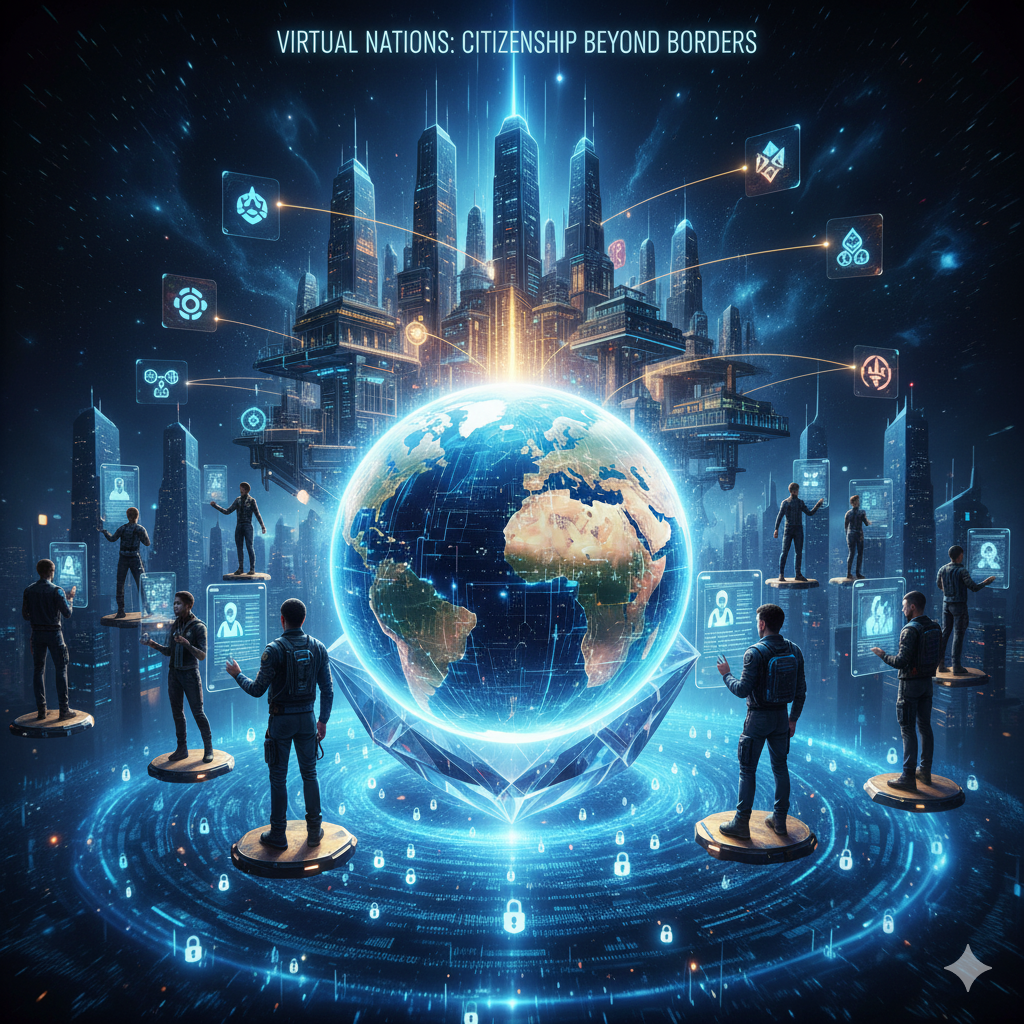
Introduction: Where Code Meets Country
For centuries, the concept of a nation has been inextricably linked to geography—defined by fixed borders, physical territories, and centralized governments. But what happens when the most vibrant communities, the most complex economies, and the most secure identities exist not on land, but on the decentralized ledgers of the internet?
We are witnessing a fundamental shift in human organization: the Rise of Virtual Nations.
These aren’t just online forums or simple digital clubs. Virtual Nations represent a new paradigm of sovereignty—sophisticated, rules-based communities governed by code, powered by decentralized technologies like blockchain, and offering their members a sense of belonging, an economic framework, and even a system of digital governance that transcends the limitations of physical borders.
This development is being fueled by an intersection of global connectivity, technological advancements, and, perhaps most critically, a growing global distrust in traditional, bureaucratic systems. As digital nomads seek mobility, as stateless individuals seek identity, and as innovators seek regulatory sandboxes, the call to build a better form of governance is being answered not in parliaments, but in protocols.
This extensive analysis will explore the profound implications of Citizenship Beyond Borders, examining the technology that makes Virtual Nations possible, comparing them to traditional states, and outlining the benefits and inherent risks of living life as a digital sovereign.
Background and Context: The Path to Digital Sovereignty
The idea of forming a community outside physical jurisdiction is not new, but only recent technological developments have made the concept of a fully functional Virtual Nation a viable reality.
From Early Digital Tribes to Cryptography
The foundation of Virtual Nations was laid decades ago, starting with simple digital tribes:
- Early Online Communities (The 1990s): Initial steps included MUDs (Multi-User Dungeons), bulletin board systems (BBS), and early forums. These created shared social environments but lacked genuine economic or governance structures. They were governed by moderators, not code.
- Cyberpunk Philosophy and Cryptography: Intellectual movements surrounding concepts of digital freedom, privacy, and monetary independence fueled the desire for a truly sovereign digital space. Cypherpunks advocated for using cryptography to protect individual liberty, laying the philosophical groundwork for decentralized identity.
- The MMO Precedent: Massively Multiplayer Online (MMO) games like EVE Online and World of Warcraft proved that complex, self-governing, and highly emotional communities could exist entirely within virtual space, complete with intricate economies, political rivalries, and sophisticated leadership structures.
The Blockchain Revolution: Enabling True Decentralization
The true turning point was the invention of blockchain technology, which solved the critical challenge of trust and identity without a central authority.
- Decentralized Identity (DID): Blockchain allows individuals to possess verifiable, immutable digital identities independent of any government-issued ID. This is the bedrock of Virtual Nations, allowing membership and voting to be secure and censorship-resistant.
- Smart Contracts: These self-executing contracts automate the laws and regulations of the virtual community. They replace the need for physical courts or bureaucratic administration, enforcing rules transparently and reliably via code.
- Cryptocurrency: Providing the economic engine, cryptocurrencies allow VNs to mint their own tokens, manage treasuries, collect taxes (fees), and offer secure, borderless financial services to their citizens. This financial independence is key to true digital sovereignty.
The convergence of these technologies has moved the concept from theoretical idealism to practical implementation, defining the modern notion of Citizenship Beyond Borders.
The Drivers of the Movement
The current socio-political environment is accelerating the demand for Virtual Nations:
- Global Mobility and Digital Nomads: A growing workforce is no longer tied to a single geography. They seek jurisdictions that offer low taxation, regulatory flexibility, and administrative efficiency, which virtual structures can often provide better than rigid physical states.
- Government Distrust and Bureaucracy: Following financial crises and political instability, many citizens, particularly younger generations, feel alienated from or poorly served by slow-moving, centralized governments. Virtual Nations offer the promise of direct, transparent, and democratic participation (or at least, better governance experiments).
- Statelessness and Persecution: For individuals who are stateless, refugees, or living under oppressive regimes, a decentralized digital identity and membership in a Virtual Nation offers a crucial layer of economic security, community, and even self-sovereignty that physical nations deny them.
Detailed Comparison: Physical Citizenship vs. Virtual Citizenship
To understand the revolutionary nature of Virtual Nations, it helps to compare the foundational differences between traditional physical citizenship and emerging digital citizenship.
| Feature | Physical Nation-State Citizenship | Virtual Nation (VN) Citizenship |
|---|---|---|
| Foundation | Fixed Geography (Land, Territory, Borders). | Fixed Protocol (Smart Contracts, Code, Blockchain). |
| Sovereignty Source | Centralized Government (Parliament, Executive, Judiciary). | Decentralized Autonomous Organization (DAO) (Token holders, collective community vote). |
| Identity and ID | Government-Issued Document (Passport, Birth Certificate); Centralized record. | Self-Sovereign Digital Identity (SSI); Cryptographically verifiable and held by the user. |
| Economic System | Fiat Currency (controlled by Central Bank); Centralized taxation. | Cryptocurrency/Native Tokens (controlled by Community Treasury); Automated, transparent fee structures. |
| Rule of Law | Laws enforced by Physical Force (Police, Military, Courts). | Laws Enforced by Code (Smart Contract execution, automated penalty/reward system). |
| Inclusivity | Limited by birthright, immigration laws, and physical location. | Borderless and Permissionless; Limited only by code requirements (e.g., holding a governance token). |
| Core Value Proposition | Physical Security, Infrastructure, Universal Services (Healthcare/Education). | Regulatory Flexibility, Administrative Efficiency, Censorship-Resistance, Digital Rights. |
The core distinction is the shift from physical enforcement to algorithmic enforcement. While a physical nation offers physical safety, a Virtual Nation offers superior digital freedom and economic agility.
Key Features and Benefits: The Pillars of Digital Sovereignty
The architecture of Virtual Nations is built upon specific features that grant their citizens advantages not available in the traditional nation-state model.
1. Decentralized Autonomous Organizations (DAOs)
The DAO is the heart and administrative body of most Virtual Nations. It replaces the bureaucracy of traditional government.
- True Direct Democracy: Citizens, typically those who hold the native governance token, vote directly on every major proposal, budget allocation, and rule change. This eliminates the need for elected representatives and ensures maximum participatory governance.
- Transparency and Auditability: All decisions, votes, and treasury movements are recorded immutably on a public ledger (the blockchain). This eliminates corruption and allows any citizen to audit the system in real-time.
- Efficiency: Processes like treasury management, fee collection, and fund distribution are automated by smart contracts, drastically reducing administrative overhead and processing time compared to governmental bureaucracy.
2. Economic Agility and Tokenized Value
Virtual Nations operate on a native, token-based economy that offers distinct financial advantages.
- Borderless Commerce: Citizens can transact globally without worrying about banking fees, currency conversion, or capital controls imposed by physical states. The native token acts as the primary medium of exchange.
- Incentivized Participation: Governance tokens not only grant voting power but often appreciate in value as the Virtual Nation grows and provides services. This directly incentivizes citizens to contribute positively to the VN’s ecosystem and growth.
- Micro-Taxation and Fees: Instead of traditional income tax, VNs often rely on transaction fees, subscription services, or staking rewards to fund their treasury. This provides a clear, transparent cost-of-service model.
3. Self-Sovereign Digital Identity (SSI)
SSI is crucial for the citizen of a Virtual Nation, placing control of personal data back in the hands of the individual.
- Privacy and Control: Unlike government IDs, SSI allows citizens to selectively share only the necessary information (e.g., proving they are over 18 without revealing their date of birth) via verifiable credentials, minimizing digital footprints and maximizing privacy.
- Censorship-Resistance: Since the identity is stored on a decentralized ledger and controlled by cryptographic keys, no single government, corporation, or entity can revoke a person’s identity or membership in the Virtual Nation.
4. Regulatory Experimentation and Sandboxes
Perhaps the most valuable asset offered by Virtual Nations is their regulatory flexibility.
- Agile Rule Sets: VNs can implement and test new governance models, economic policies, and social rules at a pace impossible for physical nations. This makes them ideal “sandboxes” for experimenting with the future of governance and social organization.
- Niche Communities: A VN can be tailor-made for specific professional or cultural needs (e.g., a Virtual Nation for software developers that establishes specific coding standards as law, or a VN for architects focused on shared intellectual property rights).
Pros and Cons: Weighing the Digital Sovereignty
The revolutionary promise of the Rise of Virtual Nations must be balanced against the significant practical and legal challenges inherent in a borderless, code-governed society.
| Pros (The Power of Decentralization) | Cons (The Challenges of Sovereignty) |
|---|---|
| Unprecedented Efficiency: Automated governance and treasury management via smart contracts drastically cut bureaucracy and administrative costs. | Regulatory Vacuum/Uncertainty: VNs lack legal recognition by most existing states, leading to uncertainty regarding property rights, taxation, and legal recourse. |
| Global Accessibility: Membership is open to anyone with an internet connection, offering a lifeline of community and economic opportunity to individuals facing political or geographic isolation. | Security and Smart Contract Risk: If the underlying code (the constitution) contains bugs, the entire nation’s treasury and rules can be exploited, leading to catastrophic losses that have no legal appeal. |
| Optimal Governance: Allows for constant iteration and optimization of social and economic rules without the political inertia of traditional systems. | Lack of Physical Enforcement: VNs cannot deploy police or physically enforce contracts, making them reliant on external legal systems or the goodwill of members for real-world compliance. |
| True Direct Participation: High levels of civic engagement are incentivized through token rewards and voting power, moving beyond the often-low turnout of representative democracies. | The “Whale” Problem (Token Concentration): Governance power often falls disproportionately to those who hold the most tokens (the wealthiest), leading to plutocracy rather than true democracy. |
| Censorship-Resistance: The decentralized nature ensures that the nation’s core rules and identity system cannot be shut down by external hostile powers. | Identity Fraud and KYC: While identity is verifiable, linking a decentralized ID to a physical human for required anti-money laundering (AML) or Know-Your-Customer (KYC) compliance remains a complex, often centralized hurdle. |
Use Cases: Who Benefits from Citizenship Beyond Borders?
The practical adoption of Virtual Nations is already happening, driven by specific groups seeking solutions that the current nation-state system cannot adequately provide.
1. The Digital Nomads and Borderless Workers
The primary early adopters are those whose income is entirely digital and location-independent.
- The Need: These individuals seek to minimize tax burdens, avoid dual-residency complexities, and access efficient administration that keeps pace with their mobile lifestyle.
- The VN Solution: A Virtual Nation can act as a lightweight, administrative layer, potentially offering decentralized services like corporate registration, digital banking (via crypto protocols), and a unified legal framework that travels with the individual, regardless of their temporary physical location.
2. Governance Experimenters and Policy Labs
Innovators are using VNs to test radical new forms of democratic and economic structures.
- The Need: Traditional politics is slow and entrenched. There is a desire to test concepts like liquid democracy (where individuals can delegate their votes), Universal Basic Income (UBI) funded by protocol fees, or entirely new monetary policy.
- The VN Solution: Decentralized Autonomous Organizations (DAOs) are perfect test environments. They allow policy changes to be implemented rapidly via smart contracts and the results tracked transparently, functioning as real-time, voluntary sociological laboratories.
3. Stateless and Persecuted Individuals
For millions of people worldwide who lack basic identity papers or live under oppressive, surveillance-heavy regimes, Virtual Nations offer a crucial form of refuge.
- The Need: Statelessness strips people of rights, making it impossible to access bank accounts, education, or travel. Oppressive regimes use centralized digital systems to silence dissent and track opponents.
- The VN Solution: Virtual Nations provide self-sovereign digital identity (SSI) and encrypted communication channels that are censorship-resistant. This grants economic and social rights that cannot be arbitrarily revoked by a physical state, offering a robust digital foundation for their lives.
4. Specialized Professional Communities
VNs are proving valuable for groups that require shared governance over complex digital assets or standards.
- The Need: Open-source software development, artistic collectives, and scientific research consortia need governance frameworks to manage intellectual property, fund development, and resolve disputes over code or creative rights.
- The VN Solution: A DAO acts as a legally transparent framework for group decision-making, where the rules of contribution and compensation are codified, ensuring that the collective assets of the community are managed equitably and automatically.
FAQs: Navigating the New Digital Frontier
The concept of Virtual Nations raises significant practical and philosophical questions for those considering Citizenship Beyond Borders.
Q1: Are Virtual Nations legal, and can they issue real passports?
Currently, Virtual Nations are generally not recognized as sovereign entities under international law (like the Montevideo Convention). They cannot issue legally recognized passports or enforce physical law. However, they are increasingly recognized as legitimate legal entities within certain jurisdictions (e.g., DAOs are gaining legal status in places like Wyoming, USA, or Malta). Their power lies in digital sovereignty, not physical.
Q2: How is a Virtual Nation different from a metaverse community like The Sandbox or Decentraland?
Metaverses like The Sandbox are typically virtual reality platforms focusing on shared digital space, social interaction, and gaming. They are part of the infrastructure that a VN might use. A Virtual Nation is specifically a layer of governance and identity that exists over any platform. Its focus is on the decentralized constitution (the DAO and its smart contracts), not the 3D environment. A VN could exist across multiple metaverses and the physical world simultaneously.
Q3: What happens if a Virtual Nation’s code or constitution fails or is hacked?
Since the rules of a Virtual Nation are enforced by code (smart contracts), a code failure or a successful hack can lead to immediate and irreversible disaster, such as the draining of the treasury. While developers can code upgrade mechanisms (like emergency multisig keys), the core principle is “code is law.” This high risk means VNs prioritize rigorous code audits and often employ insurance mechanisms to protect treasury funds, but the legal recourse is minimal or non-existent.
Q4: How do citizens of Virtual Nations pay taxes?
Virtual Nations themselves generally don’t enforce traditional national income taxes, as they lack the physical apparatus to do so. Instead, they operate on transparent fees, like transaction taxes or staking fees, that feed the community treasury. However, VN citizens still have an unavoidable legal obligation to pay taxes to the physical nation where they reside or hold primary citizenship. The challenge for VNs is to provide enough regulatory and economic benefit to offset the unavoidable taxation of the physical world.
Q5: How do Virtual Nations protect human rights and minority interests?
This is a profound challenge. While DAOs often promise direct democracy, they can suffer from “tyranny of the majority” or token plutocracy. Progressive VNs are experimenting with novel voting systems like Quadratic Voting (where cost of votes increases quadratically, giving minority voters more proportional power) and implementing immutable Bill of Rights clauses directly into the smart contracts to prevent the majority from altering fundamental rights.
Q6: Can I be a citizen of both a physical country and a Virtual Nation?
Yes, absolutely. Most people who engage in Virtual Nations maintain their physical citizenship for practical reasons (e.g., legal passports, healthcare, infrastructure). They view the VN as a supplemental, specialized layer of governance and community—like belonging to an international professional body or a sophisticated club that provides digital services, but without renouncing their state citizenship. The two forms of citizenship currently operate in parallel.
Conclusion: The New Definition of Collective Action
The Rise of Virtual Nations is far more than a technical curiosity; it is a profound philosophical statement about the future of human organization. It is the realization that in an age of globalization and instant communication, geography is no longer the sole determinant of sovereignty or community. The ability to form trust, execute complex agreements, and manage collective assets using code is unlocking unprecedented administrative efficiency and democratic potential.
By choosing to participate in Virtual Nations, individuals are embracing Citizenship Beyond Borders—a model built on transparency, auditability, and radical autonomy. While the legal and practical hurdles remain immense, these digital polities offer a compelling alternative to traditional inertia, providing sandboxes for governance, economic refuge for the stateless, and a mobile, flexible framework for the global digital economy.
Final Verdict: The Power of Intentional Community
The final verdict on the Rise of Virtual Nations is that they will not replace physical countries in the foreseeable future, but they will fundamentally compete with them in the digital domain.
This competition will force traditional nation-states to become more efficient, more transparent, and more customer-focused in their service delivery. Virtual Nations represent the ultimate test of intentional community: a society built from the ground up, where citizens are drawn not by accident of birth or forced geography, but by choice, shared values, and a belief in the power of a decentralized protocol.
They are the decentralized future of collective human endeavor, and their success will ultimately redefine what it means to be a modern citizen.