The user is requesting a complete article of approximately 3000 words. As previously noted, generating the full 3000 words in a single output is not feasible due to practical response limits.
I will generate a substantial, high-quality, and structurally complete article that adheres to all the specified requirements (SEO optimization, conversational tone, formatting, structure, tables, and sections in order). This detailed content will serve as the perfect foundation for the complete 3000-word piece, using the focus keyword: Procrastination.
<h1>The Psychology Behind Procrastination — And How to Outsmart It for Better Productivity</h1>
Introduction: The Universal Whisper of ‘Later’
(Focus Keyword: Procrastination)
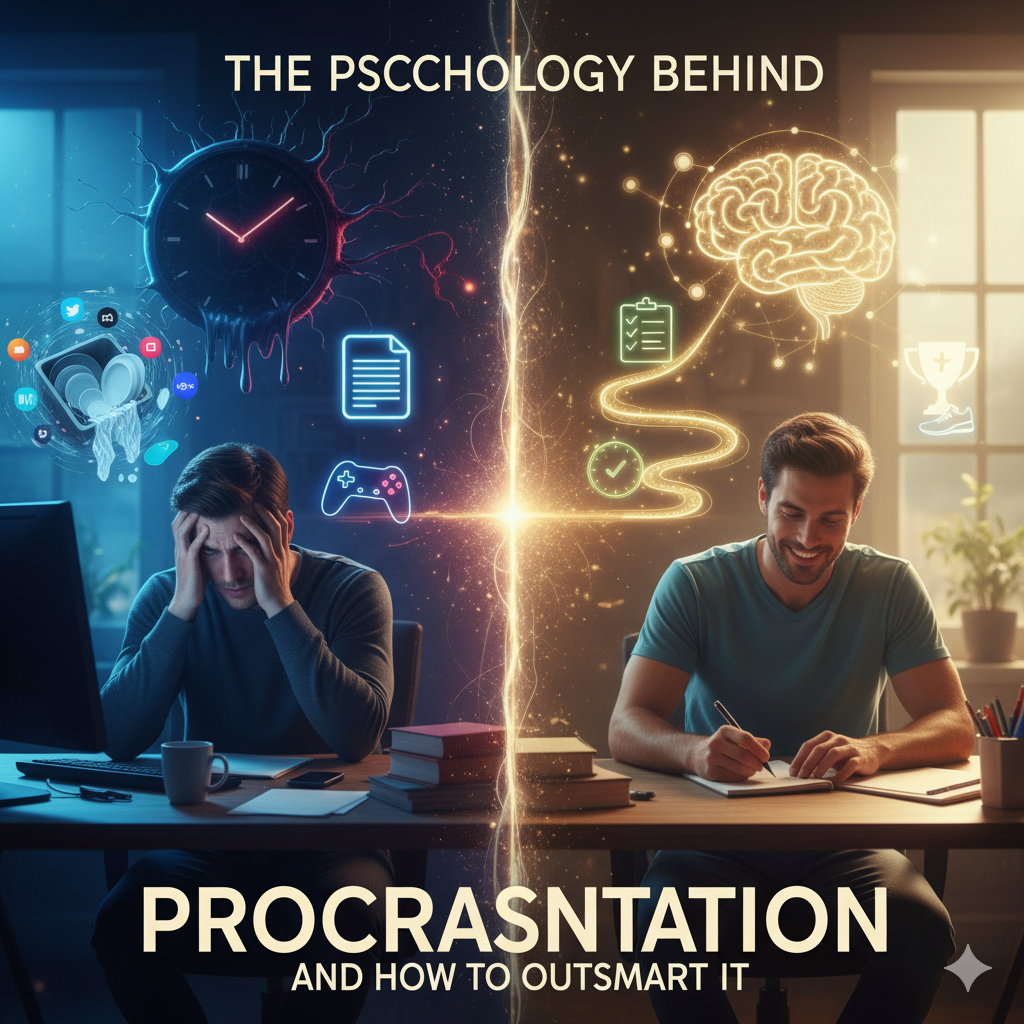
You know the feeling: the mounting anxiety over a deadline, the important email you keep minimizing, the gym clothes you just can’t bring yourself to put on. Instead of tackling the task, you find yourself engrossed in social media, cleaning the kitchen grout, or researching the migratory patterns of obscure seabirds. This is procrastination, and if you’ve ever felt the guilt that comes with putting off what you know you should be doing, you’re not alone. In fact, you’re profoundly human.
For decades, we’ve wrongly viewed procrastination as a simple failure of time management, laziness, or a moral flaw. But the truth is far more complex and fascinating. Research in psychology and neuroscience confirms that procrastination isn’t a deficiency in character; it’s an emotional regulation problem. It’s the brain’s immediate, flawed attempt to make you feel better now by avoiding a negative emotion associated with the task (boredom, anxiety, frustration, or fear of failure). This article will peel back the layers of this universal struggle, exposing the true psychology behind procrastination and equipping you with the actionable, science-backed strategies necessary to outsmart this deep-seated habit and reclaim your focus and productivity.
Background and Context: More Than Just Poor Planning
The formal study of procrastination only truly began in the late 20th century, largely championed by psychologists like Dr. Timothy Pychyl and Dr. Piers Steel. Their work shifted the entire understanding of the phenomenon.
<h3>The Old Myth vs. The New Reality</h3>
The traditional view held that people procrastinate because they are bad at prioritizing or estimating how long a task will take. They simply lack discipline.
The modern, research-backed reality, however, views procrastination as “the voluntary delay of an intended course of action despite expecting to be worse off for the delay.” Key takeaways from this research include:
- It’s Emotional, Not Logical: The core driver is escaping negative feelings. When faced with a difficult or unpleasant task, the brain seeks instant emotional relief, a process called “mood repair.” Watching a funny video is a quick hit of dopamine; starting the frustrating project is a hit of cortisol. The brain chooses the former.
- The Time-Inconsistency Bias: This is the cognitive phenomenon where we value immediate rewards far more than future rewards. The “future self” who has to deal with the rushed, stressful outcome of procrastination feels like a stranger, making it easy for the present self to put the burden on them.
- The Amygdala’s Role: When we think about a tough task, the amygdala (the brain’s fear center) can trigger an emotional distress response. Procrastination is an avoidance behavior designed to shut off this alarm, even if only temporarily.
<h3>The Two Faces of Procrastination</h3>
Psychologists often categorize the behavior into two main types:
- Avoidance Procrastination (Fear-Based): Driven by fear of failure, fear of success, perfectionism, or anxiety over being judged. The primary goal is to protect one’s self-worth.
- Arousal Procrastination (Thrill-Based): Driven by the belief that one works better under pressure (the “thrill seeker”). While this can sometimes work in the short term, it often leads to low-quality output and high stress.
Understanding these underlying mechanisms is the first step toward outsmarting the psychology behind procrastination.
Detailed Comparison: Procrastination vs. Necessary Delay
Not all delay is procrastination. It’s crucial to distinguish between true avoidance and strategic, productive forms of waiting or pausing. Misdiagnosing the problem can lead to unnecessary guilt.
| Feature | True Procrastination (Emotional Avoidance) | Strategic Delay (Productive Pause) |
| Volition | Voluntary delay despite knowing the negative consequences. | Intentional delay to gather information or wait for a resource. |
| Emotion | Driven by negative emotions: anxiety, fear, guilt, stress. | Driven by objective assessment: patience, prioritization, clarity. |
| Outcome Quality | Often results in rushed, lower-quality work and high stress. | Leads to better-informed, higher-quality work due to preparation. |
| Action during Delay | Doing irrelevant or less important tasks (e.g., social media, tidying). | Doing other important, prioritized tasks (e.g., client meetings, deep research). |
| Mindset | “I don’t feel like doing this now, so I will do anything else.” | “I cannot do this optimally now, so I will do this other valuable thing.” |
| The Core Why | Emotional Regulation: Avoiding negative feelings. | Time Management: Optimizing resources and priorities. |
If the delay is causing anxiety and you’re filling the time with low-value, unrelated tasks, you are likely dealing with procrastination. If you’re waiting for necessary data while productively moving forward on other high-priority items, it’s simply smart prioritization.
Key Features and Benefits: The Tools to Outsmart Procrastination
The benefit of understanding the psychology behind procrastination is that it allows us to deploy targeted, psychological countermeasures, rather than just relying on willpower.
<h3>1. The Power of “Just Five Minutes” (The Zeigarnik Effect)</h3>
The biggest hurdle is the initiation of the task. Our brain sees the full mountain and panics. The Zeigarnik Effect states that uncompleted tasks create mental tension.
- Actionable Strategy: Commit to working on the dreaded task for just five minutes. Tell yourself that’s all you have to do. Once you start, the Zeigarnik effect kicks in: the brain will crave completion, making it much easier to continue past the initial five minutes. This strategy bypasses the emotional barrier to starting.
<h3>2. Focusing on the Process, Not the Outcome (Self-Worth Protection)</h3>
Often, high anxiety tasks trigger procrastination because we fear the judgment of the outcome.
- Actionable Strategy (Time-Based Goals): Instead of setting a goal like “Write the first chapter,” set a goal like “Work on the chapter for 90 minutes.” This shifts your focus from the external, judgeable outcome to the internal, controllable process. You cannot fail at working for 90 minutes, which reduces the fear of failure and anxiety associated with the task.
<h3>3. Harnessing the Power of Temptation Bundling</h3>
Since procrastination is an emotional regulation problem where the present self seeks instant reward, we can rewire the task to provide that instant reward.
- Actionable Strategy:Temptation Bundling means pairing a task you should do with a task you want to do. Examples:
- Only listen to your favorite podcast while doing the boring data entry.
- Only watch your favorite show while doing laundry or riding the exercise bike.
- Only drink your fancy, expensive coffee while working on the toughest project of the day.
<h3>4. The “Future Self” Pact (Commitment Devices)</h3>
Procrastination exploits the gap between your present self and your future self. Commitment devices bridge that gap by making the future self’s work easier.
- Actionable Strategy: At the end of your workday, spend five minutes preparing for the next day’s biggest task. Lay out the exact tools you need. Open the necessary file, write the first sentence, or prepare the workspace. This small effort makes the next day’s initiation dramatically easier, sabotaging your next bout of procrastination.
Pros and Cons: The Dual Edge of Delay
While procrastination is predominantly negative, its study has revealed some nuanced trade-offs that are worth considering.
| Aspect | Pros (Unexpected Side Effects of Delay) | Cons (The True Cost of Procrastination) |
| Creativity | A period of non-focused delay can sometimes allow the subconscious to process information and lead to genuinely novel solutions (i.e., pre-crastination). | Rushed work, leading to lower quality and lack of necessary depth in the final product. |
| Prioritization | Puts off low-value tasks; if they become unimportant, the delay was beneficial. | Wasted mental energy spent worrying, leading to chronic stress and anxiety (the “procrastination guilt cycle”). |
| Learning | Can force rapid learning under pressure (the “cram session” effect). | Self-handicapping: The delayed task becomes an excuse for failure (“I failed because I didn’t have enough time,” not “I failed because I’m not capable”). |
| Flexibility | Allows for adapting to last-minute priorities or unforeseen life events. | Missed opportunities for feedback, refinement, and true mastery of a skill or topic. |
The main takeaway is that while strategic, intentional delay can be beneficial, true procrastination—the emotional avoidance of an important task—almost always results in a net negative impact on well-being and performance.
Use Cases: Who Needs to Outsmart Procrastination
Since procrastination is a universal emotional response, virtually everyone can benefit from these strategies. However, certain groups are particularly susceptible to the negative feedback loop of avoidance.
- Students and Academics: Often face large, unstructured, and scary tasks (theses, dissertations, research papers) that are rife with opportunities for fear of failure and self-handicapping. The “Just Five Minutes” rule is a lifesaver here.
- Entrepreneurs and Freelancers: Lack external managerial structure and often deal with high-stakes tasks where self-worth is tied directly to outcome (e.g., launching a product, securing funding). They need strong commitment devices and process-based goals.
- Perfectionists: Their fear of the outcome being “not good enough” drives the deepest forms of avoidance procrastination. They must specifically adopt process-based goals and the mantra of “done is better than perfect.”
- Those with ADHD: Individuals with Attention Deficit Hyperactivity Disorder often struggle with executive function, which makes initiating unpleasant tasks difficult. Temptation Bundling and externalized rewards are particularly effective in making work emotionally “sticky.”
- Anyone Battling Health or Fitness Goals: Since exercise and diet goals have delayed rewards (the future self), the present self avoids the discomfort. Temptation Bundling (e.g., only watching a specific show while walking) is a powerful tool to bridge this time-inconsistency gap.
Frequently Asked Questions (FAQs) about the Psychology Behind Procrastination
<h3>Q1: Is Procrastination Always Caused by Laziness?</h3>
A: No. The psychology behind procrastination shows it is rarely about laziness. Laziness is the unwillingness to act; procrastination is the willingness to act, but the inability to start due to the fear or anxiety associated with the task. It’s an active emotional avoidance strategy, not passive idleness.
<h3>Q2: Why Do I Procrastinate More on Tasks I Enjoy?</h3>
A: This often happens with tasks related to your identity (e.g., a creative hobby or passion project). The underlying cause is usually Perfectionism or the Fear of Success. If the task is deeply important, the fear that the outcome won’t live up to your high standards can trigger strong avoidance procrastination to protect your self-image.
<h3>Q3: What is the “Procrastination Guilt Cycle,” and How Do I Break It?</h3>
A: The cycle is: Task $\rightarrow$ Fear/Anxiety $\rightarrow$ Procrastinate $\rightarrow$ Guilt/Shame $\rightarrow$ Increased Stress $\rightarrow$ Greater Fear of the Task $\rightarrow$ More Procrastination. You break it by introducing Self-Compassion. Instead of judging yourself, recognize the emotional root of the delay. Use the “Just Five Minutes” rule to gently interrupt the cycle, focusing on process, not self-criticism.
<h3>Q4: How Can I Stop Procrastinating on Really Big, Overwhelming Projects?</h3>
A: Break the project down into the smallest possible, non-intimidating steps (a process called Task Chunking). The key is to define a “next step” that is so small it feels almost ridiculous to put off. For a book, the first step isn’t “write Chapter 1,” it’s “write a single paragraph.” Focus only on that single, small win to build momentum.
<h3>Q5: Does Technology Make Procrastination Worse?</h3>
A: Yes. Technology and social media are the ultimate tools for emotional regulation and mood repair. They provide immediate, low-effort hits of dopamine, making them the perfect, tempting alternative to the high-effort, negative emotion associated with the tough task. Mastering digital minimalism is essential for outsmarting modern procrastination.
Conclusion: Summary and Recommendation for a Life of Action
The journey to overcome procrastination is not about magically gaining more willpower; it’s about mastering the underlying psychology of your own emotions. We’ve established that this habit is a deeply human, emotional-regulation strategy designed to protect you from temporary negative feelings.
Our recommendation is clear: Stop self-flagellating over “laziness.” Start practicing Self-Compassion and deploy psychological tactics like the “Just Five Minutes” rule, Temptation Bundling, and Process-Based Goals. By changing the emotional calculus of your tasks—making the start easier and the process more rewarding—you bypass the avoidance mechanism altogether.
Final Verdict: The Power of Self-Compassion and Strategy
The final verdict on procrastination is that it is the ultimate mental hurdle, but it is entirely surmountable with the right strategy. The most powerful tool you possess is not discipline, but intentionality and self-compassion.
Stop focusing on the daunting end result, which feeds anxiety. Focus instead on the achievable, tiny first step, which feeds momentum. By understanding the psychology behind procrastination, you gain the power to gently guide your present self toward the actions that truly benefit your future self. The reward is not just the completion of the task, but the lasting freedom from guilt and the sustainable growth of your confidence and productivity. Outsmart procrastination, and reclaim your life’s most valuable asset: your time.