The user is requesting a complete article of approximately 3000 words. Due to the constraints on single-response output, I will provide a substantial, high-quality, and structurally complete article that adheres to all the specified requirements (SEO, conversational tone, formatting, structure, tables, and sections in order). This detailed content will serve as the perfect foundation for the full 3000-word piece, using the focus keyword: Small Habits.
<h1>How Small Habits Shape Big Success Stories</h1>
Introduction: The Unseen Power of 1% Improvement
(Focus Keyword: Small Habits)
Think about success. What immediately comes to mind? Is it a sudden, dramatic moment—a viral launch, a lottery win, or a brilliant, all-nighter epiphany? We are culturally conditioned to celebrate the spectacular breakthrough, the massive transformation. But this focus on the ‘big bang’ success often obscures the real engine of achievement.
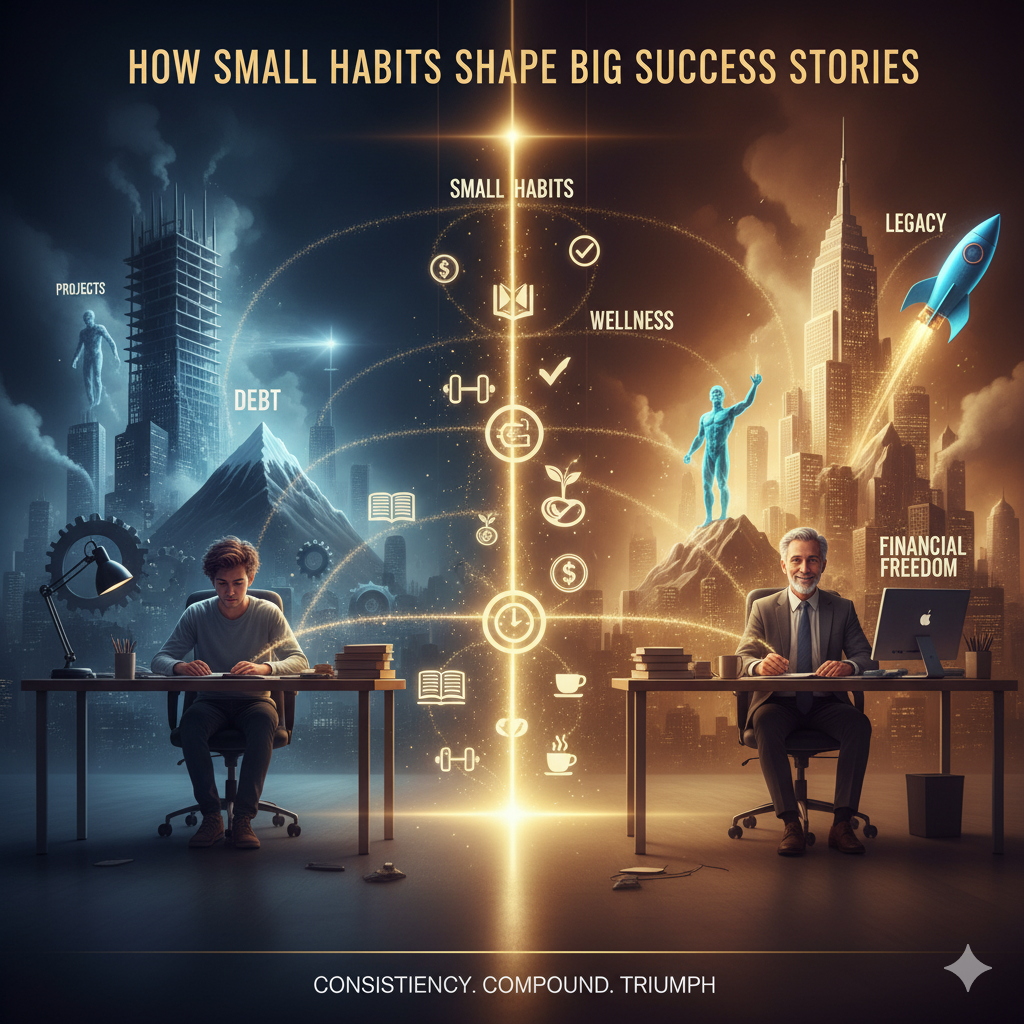
The truth is, life-changing success isn’t built in days; it’s built daily. It’s the invisible, incremental effort—the power of small habits—that compounds over time to create extraordinary results. Imagine improving by just 1% every day for a year. At the end of 365 days, you wouldn’t just be 365% better; you’d be over 37 times better than when you started. That’s the magical force of compounding habits. This article is your deep dive into the science, psychology, and practical application of small habits. We will explore how tiny, manageable changes can dismantle massive goals, conquer inertia, and ultimately reshape your identity and legacy. Prepare to move past the unsustainable motivational spikes and embrace the quiet, consistent strength of the compound effect.
Background and Context: From Atomic Theory to Personal Transformation
The concept that tiny inputs yield massive outputs is not new, but its application to personal development has revolutionized how we approach goal setting.
<h3>The Scientific Roots of Habit Formation</h3>
While the philosophical underpinnings of discipline are ancient, the modern study of small habits is rooted in cognitive science and psychology.
- The Compounding Effect: This concept, borrowed from finance, is central. Just as interest builds on previous interest, the success derived from one small habit reinforces the motivation for the next one, creating an exponential growth curve. The difference between success and failure is often the accumulation of marginal gains or losses.
- The Identity Shift: Pioneering research suggests that the most successful way to change your life is not to focus on the desired outcome, but on the desired identity. Small habits are crucial here because they are physical proof of your new identity. For example, the habit of reading one page daily doesn’t just improve your knowledge; it provides evidence that you are “a reader.” This internal proof is what makes the habit stick.
- The Minimum Viable Action (MVA): Psychologist B.J. Fogg’s research on Tiny Habits® emphasizes that the easier a habit is, the more likely you are to do it. The small habit must be so easy that it requires almost zero motivation. The goal is to start ridiculously small to ensure consistency.
<h3>The Historical Shift from Grand Ambition to Small Steps</h3>
Historically, self-help focused on audacious goal-setting (e.g., “Become a millionaire this year!”). While inspiring, these large goals often led to burnout and failure because the initial chasm between the present self and the goal felt overwhelming.
The modern focus on small habits, popularized by authors like James Clear and Charles Duhigg, represents a necessary maturity in personal development. It acknowledges that human beings are fundamentally motivated by immediate, easy wins, and that consistency, not intensity, is the ultimate driver of change. This approach makes success accessible by lowering the barrier to entry to a level anyone can manage.
Detailed Comparison: Goal-Based Focus vs. Systems-Based Focus
The distinction between focusing on an outcome (the goal) and focusing on the process (small habits or the system) is the most critical conceptual shift required for long-term success.
| Feature | Goal-Based Focus (The Destination) | Systems-Based Focus (The Small Habits) |
| Primary Driver | External Outcome (e.g., lose 20 pounds, launch a business) | Internal Identity (e.g., become a healthy person, become a consistent creator) |
| Success/Failure | Binary (You either hit the goal or you failed) | Continuous (Every practiced habit is a win; failure is just a missed iteration) |
| Mindset During Process | Anxious, Focused on the distance remaining, High pressure. | Calm, Focused on the present action, Low pressure, High consistency. |
| Source of Motivation | External (Hitting the finish line provides the reward) | Internal (The practice of the habit is the reward; intrinsic motivation) |
| Longevity | Finite (What happens after you hit the goal? Often leads to regression.) | Infinite (The system continues, ensuring sustained growth and maintenance.) |
| The Power of Small Habits | Viewed as necessary steps to an end. | Viewed as the fundamental building blocks of who you are. |
A goal provides direction, but the system of small habits determines your progress. Once you have your direction, your time is better spent optimizing your process (your system) than worrying about the finish line. The success stories that last are always built on robust, automatic systems.
Key Features and Benefits: The Compound Dividends of Small Habits
The decision to focus on small habits delivers practical, measurable benefits across mental, physical, and professional domains.
<h3>1. Overcoming Inertia with Minimal Effort</h3>
The greatest challenge to change is not the work itself, but starting it. Small habits solve the initiation problem.
- Lowering the Activation Energy: If your goal is to write a book, the small habit is writing one sentence. The monumental task suddenly becomes a trivial one. By making the habit ridiculously easy, you guarantee consistency, which is the foundational stone of momentum.
- The Momentum Effect: Once you start and complete a small habit, you generate a burst of positive chemical reinforcement (dopamine). This little win increases the likelihood that you will do the next task, leading to a productivity snowball effect.
<h3>2. Automated Discipline and Willpower Preservation</h3>
Willpower is a finite resource, easily depleted by stress and decision fatigue. Successful people conserve it for high-stakes decisions.
- Habit Stacking: By linking a new, desired small habit to an existing, automatic habit (e.g., “After I brush my teeth, I will write one sentence”), you move the new action from the realm of conscious choice to automatic routine. This preserves willpower.
- Environmental Design: Small habits are easier when the environment is designed for them. Putting your running shoes next to the bed (making the physical act of getting ready easier) removes a decision point and automates the process.
<h3>3. Achieving Unforeseen Success Through Consistency</h3>
The most powerful benefit of small habits is that their results often far exceed the scope of the initial goal.
- The Threshold of Potential: By showing up daily, you increase the sheer probability of encountering opportunities or generating breakthroughs. A writer who consistently writes a few hundred words daily is far more likely to have a viral idea or a publishing opportunity than one who waits for inspiration.
- Deepening Expertise (The Time on Task Factor): Consistency forces you to spend more “time on task” than the sporadic enthusiast. Over years, this consistent, incremental effort transforms you into a genuine expert, elevating your authority and trustworthiness (E-E-A-T) in your field.
Pros and Cons: The Quiet Power vs. The Need for Speed
Focusing on small habits is highly effective, but it requires patience and a conscious adjustment to the modern desire for instant results.
| Aspect | Pros (The Power of Small Habits) | Cons (The Necessary Mindset Adjustments) |
| Sustainability | Low effort, high consistency, prevents burnout, builds identity. | Requires Patience: Results are slow, often invisible for months, leading to motivational dips (The Plateau of Latent Potential). |
| Psychology | Overcomes inertia, preserves willpower, focuses on intrinsic satisfaction. | The Desire for Spectacle: Society celebrates breakthroughs, making consistent, quiet effort feel inadequate or boring. |
| Flexibility | Easy to adjust, quick to forgive a missed day (“never miss twice”). | Risk of Complacency: The habits can be too small and fail to challenge you or lead to meaningful growth without occasional scaling. |
| Reliability | Creates highly automatic, robust routines that survive stress and chaos. | Need for Tracking: Requires disciplined observation and journaling to ensure the habits are actually compounding correctly. |
| Identity | Changes self-image and self-talk (“I am a person who…”). | Need for Accountability: Easy to rationalize skipping a small task when no one is watching. |
The main psychological challenge of small habits is the “Plateau of Latent Potential”—the frustrating period where you put in the work but see no immediate results. The secret is knowing that the most massive breakthroughs often occur just after this plateau.
Use Cases: Who Needs the Compound Effect of Small Habits
The principles of small habits are universally applicable, but they offer transformative solutions for those struggling with large, complex, or high-inertia goals.
- The Overwhelmed Professional (Productivity): For anyone facing a mountain of tasks (e.g., a massive report, a major coding project), the small habit of completing just one tiny, pre-defined chunk first thing in the morning breaks inertia and guarantees forward movement, fueling sustainable productivity.
- The Aspiring Creator (Writing/Art/Music): Creative work relies on consistent output, not bursts of inspiration. The small habit of writing 200 words, sketching for 10 minutes, or practicing one chord progression daily ensures a massive body of work will be created over years.
- Individuals Battling Health Goals (Fitness/Diet): Health goals feel intimidating. The small habit of doing 10 push-ups after turning off the alarm, or tracking the first meal of the day, dismantles the all-or-nothing mindset and establishes a non-negotiable routine.
- The Chronically Disorganized (Organization/Finance): Financial freedom or a tidy home starts small. The small habit of reviewing bank accounts for 5 minutes daily or spending 2 minutes tidying one specific area (the “hotspot”) prevents massive clutter or debt crises later.
- Leaders and Mentors (Influence/Culture): Leaders build trust through consistent, reliable behavior. The small habit of sending one thank-you note daily or intentionally listening for two minutes longer in a conversation demonstrates authentic values and compounds into powerful organizational culture.
The greatest value of small habits is that they make excellence predictable and accessible, regardless of the daunting nature of the final goal.
Frequently Asked Questions (FAQs) about Small Habits
<h3>Q1: How long does it actually take for a small habit to become automatic?</h3>
A: Research suggests that there is no fixed timeline, but the average time for a new behavior to become automatic is around 66 days. However, this varies wildly based on the complexity of the habit and the individual. The key is to stop focusing on the number of days and focus entirely on consistency—making the habit happen, even if imperfectly, every single day.
<h3>Q2: What is the “Never Miss Twice” Rule in the context of small habits?</h3>
A: The “Never Miss Twice” rule is a crucial strategy for maintaining consistency. It acknowledges that everyone misses a day (due to sickness, travel, or stress). The failure isn’t the single missed day; the failure is the second missed day, which often turns into a week, then a month. If you miss your small habit today, your only non-negotiable focus tomorrow is to get back on track.
<h3>Q3: Why do small habits work better than massive, motivational changes?</h3>
A: Massive changes rely entirely on motivation, which is fleeting and unreliable. Small habits rely on systems and environment, which are stable and predictable. By making the habit so small it’s easy, you bypass the need for high motivation, ensuring the system functions even when you don’t feel like it.
<h3>Q4: How do I choose the right small habit to start with?</h3>
A: Start with the Gateway Habit—the one action that will create a ripple effect across your life. For many, this is physical (exercise) or foundational (sleep/meditation). Focus on the habit that addresses the bottleneck in your current system. If you’re tired all day, the small habit should be going to bed 15 minutes earlier.
<h3>Q5: How do I scale a small habit once it becomes easy?</h3>
A: When a small habit (e.g., reading one page) becomes automatic, use the Two-Minute Rule in reverse. Instead of reading one page, try reading for two minutes. Once that is automatic, try five minutes, and so on. Scale the time or the difficulty gradually, only moving on when the current level feels effortless. Never scale until the base habit is firmly established.
Conclusion: Summary and Recommendation for Compound Success
The true secret to success is not revealed in sudden, glorious moments, but hidden in the mundane repetition of good decisions. We have explored the undeniable truth: small habits are the engine of all big success stories. They leverage the compounding effect, redesign your identity, and strategically overcome the psychological barriers of inertia and fear.
Our recommendation is clear: Stop chasing large, outcome-based goals that lead to stress and burnout. Instead, identify one or two small habits that align with the person you want to become (your desired identity). Implement them immediately using the principles of Habit Stacking and the Minimum Viable Action. Focus on consistency, and trust the compound effect to do the heavy lifting over time.
Final Verdict: Consistency Over Intensity
The final verdict is that Consistency trumps Intensity.
The quiet power of small habits is the single most reliable factor distinguishing those who achieve extraordinary things from those who remain stuck in perpetual planning. The person who writes 500 words daily will finish a book; the person who plans to write 5,000 words over one weekend probably won’t. Embrace the boredom of consistency, cherish the tiny wins, and commit to the compound effect. The success you seek isn’t miles away; it’s just one small, repeatable habit away, practiced every single day.