Introduction: The Transformation of a Pastime
For decades, video games were often dismissed as mere toys—a niche hobby for children and teenagers, a distraction from “serious” pursuits. Those days are over. What was once relegated to dimly lit arcades and basements has exploded into a global, multi-trillion-dollar phenomenon that is not only influencing entertainment but is actively reshaping education, professional training, social interaction, and even economics.
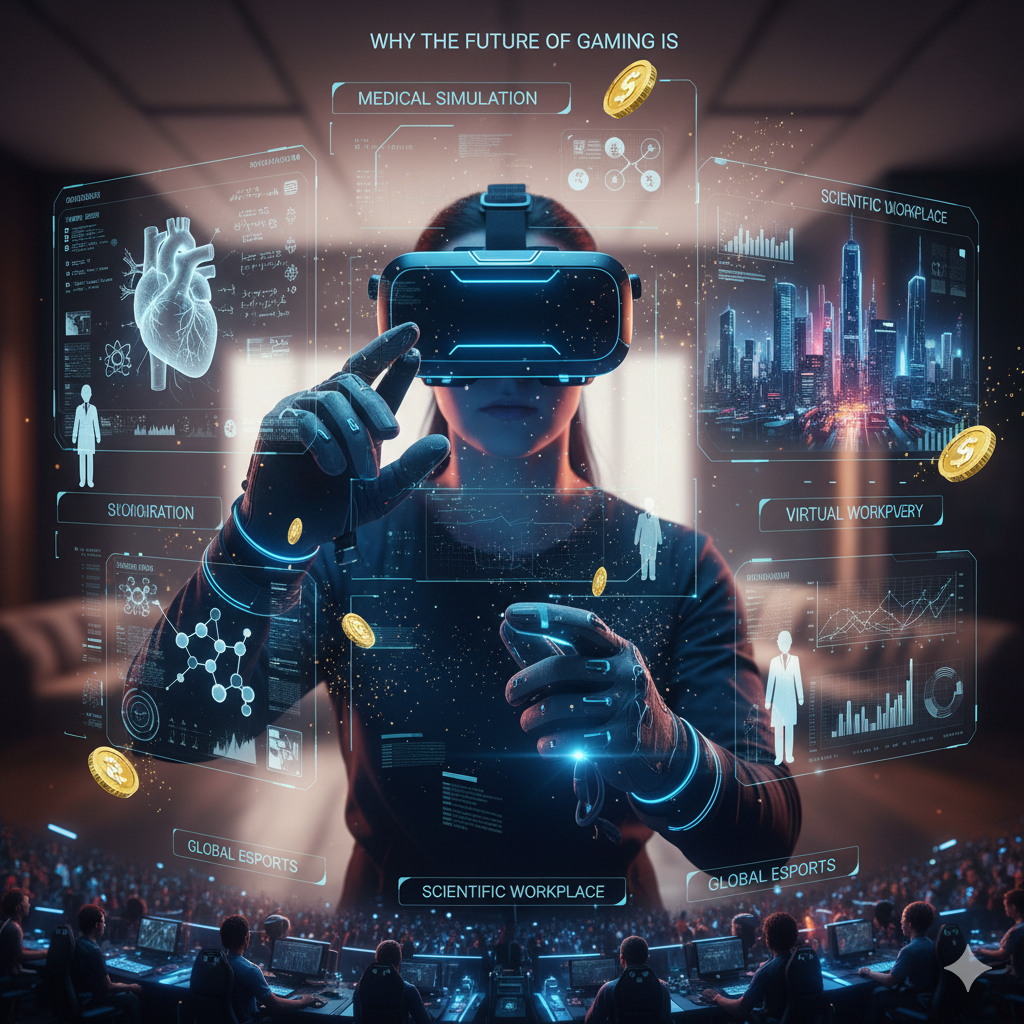
This monumental evolution is driven by advances in technology, from cloud computing to high-fidelity virtual reality, but its essence is rooted in psychology: games are powerful engines for engagement, problem-solving, and community building. This is Why the Future of Gaming Is More Than Just Play; it represents a fundamental shift in how we learn, work, and connect. The systems and mechanics that make a game fun are now being leveraged to solve some of the world’s most complex, real-world problems.
In this deep dive, we will explore the forces driving this change, compare the old paradigms of leisure with the new realities of utility, and map out the massive, non-entertainment applications that define the true value of the Future of Gaming.
Background and Context: From Arcades to Architecting Worlds
The evolution of gaming has been a journey from simple, solitary experiences to complex, interconnected virtual worlds. Understanding this trajectory is crucial to grasping its non-entertainment potential.
The Console Wars and the Rise of Immersive Storytelling
The first wave of change came with the competition between major console manufacturers (Nintendo, Sega, Sony, Microsoft). This pushed the boundaries of graphical fidelity and storytelling, establishing games not just as challenges, but as legitimate narrative art forms. However, even these blockbusters were primarily consumption-based—you played the story, and the experience ended. The value was largely limited to the player’s personal enjoyment.
The Tipping Point: MMOs and Digital Economies
The true pivot came with the rise of Massively Multiplayer Online (MMO) games and persistent virtual worlds (like World of Warcraft and Second Life). These environments introduced several concepts that laid the groundwork for the utility phase of gaming:
- Persistent Identity and Community: Players formed guilds, built relationships, and invested heavily in their digital avatars and belongings.
- Sophisticated Digital Economies: Virtual gold, items, and services began to hold real-world monetary value, leading to black markets and, eventually, regulated secondary markets.
- Complex Collaboration: Raids and competitive play required highly structured team coordination, leadership, and strategic planning—skills directly transferable to the corporate world.
It was here that the seeds were sown, proving that the motivation and engagement inherent in gaming could sustain complex, lasting systems that mirrored real-world society.
The Infrastructure Shift: Cloud, Mobile, and 5G
The final push into the utility era is a technological one. Cloud gaming (like Microsoft xCloud and Google Stadia before it) removed the dependency on expensive hardware, democratizing access. Mobile gaming introduced billions of users to the medium, making it truly pervasive. Most importantly, the combination of 5G and edge computing enables near-instantaneous, high-fidelity virtual interactions anywhere, dissolving the physical boundaries between the game and the real world. This technological infrastructure confirms Why the Future of Gaming Is More Than Just Play—it’s now the most accessible and powerful engagement platform available.
Detailed Comparison: Past Entertainment vs. Future Utility
The differences between the old perception of gaming and the modern reality are stark. The Future of Gaming is defined by its ability to generate measurable, real-world outcomes.
| Feature | Traditional Gaming (Pre-2010 Focus) | Modern Gaming & Applied Gaming (Post-2020 Focus) |
|---|---|---|
| Primary Goal | Entertainment/Leisure (Killing time, personal enjoyment, escapism). | Utility/Outcome (Skill acquisition, social capital, economic value, simulation). |
| Monetization Model | One-time purchase of a physical disc or cartridge. | Digital subscriptions, live-service models, virtual asset sales (NFTs/Skins), advertising, and data analysis. |
| Skill Value | Personal bragging rights, high scores, competitive rankings within the game. | Transferable Skills (Leadership, communication, rapid decision-making under stress, spatial reasoning). |
| Social Structure | Limited, often isolated couch co-op or structured PUGs (Pick-Up Groups). | Pervasive, persistent digital communities, global competitive leagues, cross-platform social hubs, and digital workplaces. |
| Technology Focus | Graphics, physics, rendering speed on local hardware. | Cloud streaming, AI-driven procedural content, VR/AR integration, and network stability (low latency). |
| Economic Impact | Primarily retail sales and hardware manufacturing. | Diverse sectors: Education, corporate training, mental health, scientific modeling, and a billion-dollar Esports industry. |
The transition is clear: gaming is moving from being a product you buy to being a platform that facilitates valuable interactions and outcomes.
Key Features and Benefits: The Pillars of the New Gaming Ecosystem
The real-world benefits of this new utility-focused model can be broken down into three major categories that solidify Why the Future of Gaming Is More Than Just Play.
1. Esports: Professionalism and Spectacle
Esports is the most visible sign of gaming’s maturity. No longer a casual contest, it is a massive global enterprise complete with professional athletes, multi-million dollar prize pools, corporate sponsorships (Coca-Cola, BMW), and media rights deals.
- Legitimizing Gaming Skills: Esports validates the intense cognitive skills developed through competitive play—reaction time, spatial awareness, strategy, and team coordination. A professional gamer exhibits focus and discipline comparable to traditional athletes.
- A New Media Juggernaut: Esports viewership rivals or surpasses that of traditional sports leagues in key demographics, particularly younger audiences. This has created new career paths in broadcasting, coaching, management, and content creation, establishing gaming as a lucrative and complex media domain.
2. Gamification in Education and Health
Gamification—applying game mechanics (points, badges, leaderboards, narratives) to non-game activities—is proving to be a revolutionary tool for engagement.
- Education: By turning lessons into quests and progress into rewards, platforms can dramatically boost student motivation and retention. For instance, games are used to teach complex subjects like coding, chemistry, and history, allowing students to experience the material rather than just memorize it.
- Healthcare and Rehabilitation: Games are being used for physical therapy (using motion sensors and playful environments to motivate repetitive exercises) and cognitive rehabilitation (using puzzles and timed tasks to improve focus and memory in patients with brain injuries or dementia). The fun factor provides crucial compliance that traditional therapy often lacks.
3. Virtual Worlds as Social and Economic Hubs
The concept of the metaverse, while often hyped, points to the future of gaming as persistent, shared social spaces.
- Digital Commerce: Beyond simple in-game purchases, users are buying virtual land, creating and selling digital fashion (skins), and offering services within platforms like Roblox and Fortnite. These transactions form legitimate, functioning economies with real tax implications and job creation.
- Virtual Workplaces and Events: Companies are utilizing virtual game spaces for collaboration, conferences, and large-scale public events. These spaces offer levels of immersion and interaction far superior to standard 2D video conferencing, proving that the Future of Gaming is also the future of remote work and social engagement.
Pros and Cons: The Dual Edge of Pervasive Play
As gaming integrates further into the fabric of life, its advantages and disadvantages become more pronounced. We must weigh the unprecedented benefits against the inherent societal risks.
| Pros (Enhanced Utility and Skill Development) | Cons (Ethical and Societal Risks) |
|---|---|
| Cognitive Skill Improvement: Games enhance spatial reasoning, complex problem-solving, and decision-making speed under pressure (critical for professions like surgery and military command). | Addiction and Time Displacement: The persuasive design intended for utility can lead to compulsive use, displacing essential activities like sleep, exercise, and face-to-face social interaction. |
| Globalized Income Generation: Esports, content creation, and asset trading provide new, high-value career and income opportunities, particularly for young people and those in developing nations. | Monetary Exploitation (Loot Boxes/Pay-to-Win): Aggressive monetization strategies can prey on vulnerable users, especially children, leading to financial harm and gambling-like behavior. |
| Collaborative Training Simulations: Low-cost, high-risk training for fields like aviation, emergency response, and medicine can be done in a safe, repeatable virtual environment. | Cyberbullying and Toxicity: The anonymity and intensity of competitive gaming environments can foster harassment, racism, and sexism, leading to mental distress and marginalization. |
| Accessible Social Connection: Provides powerful platforms for socializing and community building, especially for individuals with mobility issues or those who are geographically isolated. | Digital Divide and Access Inequality: Expensive hardware and high-speed internet access required for advanced VR/AR experiences can exclude lower-income populations from the emerging utility benefits. |
Use Cases: Where Gaming’s Influence is Being Applied
The most compelling proof that the Future of Gaming Is More Than Just Play lies in its adoption by non-entertainment sectors. These are high-impact examples that demonstrate the power of immersive interaction.
1. Corporate Training and Simulation
The corporate world leverages gaming principles for efficiency and safety.
- Flight and Vehicle Simulation: Pilots, surgeons, and deep-sea oil rig operators are trained almost exclusively in high-fidelity, game-engine-powered simulators. These virtual environments allow them to practice rare, catastrophic failures without real-world danger.
- Soft Skills Training: Companies use narrative-based games and virtual role-playing scenarios (often in VR) to train managers in complex soft skills like conflict resolution, diversity and inclusion, and empathetic leadership. The immersion enhances memory retention and behavioral changes far more than traditional lectures.
2. Scientific Research and Crowdsourcing Solutions
Games are being used as scientific tools to harness human problem-solving skills at scale.
- Protein Folding (Foldit): Researchers created a game called Foldit where players manipulate virtual protein structures. The collective intelligence of thousands of players has consistently found new, optimal protein folding configurations that eluded sophisticated computer algorithms, contributing directly to AIDS and cancer research.
- Citizen Science and Classification: Games like EVE Online have partnered with universities to use players’ time to classify astronomical data from telescopes, turning tedious scientific tasks into competitive achievements.
3. Mental and Physical Rehabilitation
The engagement loop of gaming is uniquely suited to rehabilitation.
- Pain Management: VR games can distract the brain and reduce the perception of pain in burn victims undergoing treatment, often requiring less pain medication.
- Post-Traumatic Stress Disorder (PTSD): Virtual reality exposure therapy (VRET), which uses gaming technology to safely and gradually expose veterans to virtual environments simulating traumatic events, has proven highly effective in helping them process and manage their symptoms.
FAQs: Understanding the New Digital Landscape
As gaming shifts from niche to necessity, certain questions frequently arise about its long-term impact and practical application.
Q1: What exactly is meant by Future of Gaming Is More Than Just Play?
It means that the core technologies, design principles, and psychological engagement loops developed for entertainment are now being repurposed for high-value applications. This includes using VR/AR for job training, gamification for education, and virtual platforms for commerce and social gathering, making the “play” element a means to a productive end.
Q2: How is gaming technology impacting real-world education?
Gaming technology moves education from passive listening to active participation. It provides interactive simulations for science, history, and engineering, allowing students to fail safely and learn through experimentation. The use of badges, levels, and progress tracking, common in games, increases motivation and makes abstract concepts tangible, accelerating learning retention.
Q3: Are Esports legitimate career paths, and how stable are they?
Esports are now absolutely legitimate career paths, offering high salaries, scholarships, and professional stability comparable to traditional sports at the top tiers. Beyond the players, the ecosystem offers sustainable careers for coaches, managers, broadcasting talent, marketers, and data analysts. Stability is improving rapidly as major media companies and colleges invest heavily in the infrastructure.
Q4: What is the role of blockchain and NFTs in the Future of Gaming?
Blockchain, NFTs (Non-Fungible Tokens), and cryptocurrency are enabling “Play-to-Earn” models. They allow players to genuinely own their in-game assets (like weapons, land, or characters). This creates true digital property rights and secondary markets, turning the time and effort invested by the player into tangible, external, and tradeable economic value. This is a crucial element in establishing the economic utility of the Future of Gaming.
Q5: How can parents manage the line between entertainment and utility in gaming?
Parents should treat gaming time like any other activity—balanced and goal-oriented. They should look for games with high utility (educational simulations, creative platforms) and monitor time spent on purely addictive entertainment platforms. The key is open communication and framing gaming not just as an escape, but as a potential skill-building and social opportunity, recognizing that the skills learned are valuable.
Conclusion: Embracing the Playbook of Tomorrow
The revolution is not coming; it is already here. The forces that shaped the simple entertainment of yesterday are now forging the complex, utility-driven platforms of tomorrow. Why the Future of Gaming Is More Than Just Play is answered by its pervasive integration into professional, educational, and social life. The core competency of the modern era is engagement, and no medium is better designed for sustained, motivated engagement than the video game.
We are entering an era where a gaming session might be a surgical practice, a team-building exercise for a multinational corporation, or an innovative physics lesson. The skills honed in these environments—rapid analysis, coordination, pattern recognition, and digital literacy—are the essential competencies required for success in the 21st-century job market.
Final Verdict: The True Value Proposition
The true value of the Future of Gaming is not measured in hours spent or sales records broken, but in the transferable value it creates. It is the most powerful learning and simulation engine ever conceived by humanity.
The verdict is a clear mandate: Gaming must be taken seriously. It is a core technological, economic, and educational platform. For society, the focus must shift from limiting “screen time” to strategically harnessing utility-based interaction. For individuals, understanding and engaging with this new reality is essential for building 21st-century skills. The playground has become the boardroom, the classroom, and the laboratory.