Think back to the commute: the jammed highways, the packed subway cars, the frantic dash to the office, often arriving already exhausted. For decades, this grind was simply “the way things are.” The office—a fixed location, a steel-and-glass monument to productivity—was the unquestioned center of the professional universe. Then, almost overnight, the world was forced to hit the reset button. The unplanned, sudden shift to remote work wasn’t just a temporary fix; it was a silent revolution that fundamentally redefined how we connect, collaborate, and create value.
This isn’t an article about the emergency transition of 2020; it’s about the permanent transformation it ignited. We’ve learned that productivity isn’t a place; it’s a practice. This paradigm shift, driven by technology and reinforced by a newfound prioritization of personal well-being, has unlocked efficiencies and opportunities previously thought impossible. In this comprehensive guide, we will delve into the history, the benefits, the challenges, and the lasting legacy of remote work, providing the expertise you need to navigate this redefined professional landscape and truly thrive outside the traditional office structure.
Background and Context: From Telecommuting to Global Teams
The idea of separating work from location is far from new. The concept of “telecommuting” was first coined in the 1970s by aerospace engineer Jack Nilles, who proposed that bringing the work to the workers, rather than the workers to the work, could save energy and reduce smog during the oil crisis. For decades, however, this remained a niche practice, primarily adopted by freelancers, highly specialized IT roles, or specific customer service centers.
The technological limitations were significant. Dial-up internet, bulky hardware, and a lack of robust video conferencing tools made effective, large-scale remote work impractical for most mainstream businesses. Management culture also played a major role; the prevailing belief was, “If I can’t see you, you’re not working,” fostering a culture of presenteeism over actual results.
<h3>The Three Pillars of the Remote Work Boom</h3>
The modern explosion of remote work was enabled by three technological and cultural breakthroughs that coincided in the late 2010s and early 2020s:
- Cloud Computing and SaaS: The migration of software and data storage to the cloud (e.g., Google Workspace, Salesforce, AWS) meant that mission-critical tools were accessible securely from any device, anywhere.
- Ubiquitous High-Speed Internet: Affordable, reliable broadband access became commonplace globally, making high-quality video calls and rapid file transfer standard.
- Advanced Collaboration Tools: The emergence of sophisticated platforms like Zoom, Slack, Microsoft Teams, and specialized project management software (Asana, Trello) recreated the sense of “being together” digitally, enabling seamless communication and documented workflows.
The external catalyst—the global health crisis of 2020—didn’t invent remote work, but it acted as the largest, most sudden pilot program in history. Companies that had resisted the change were forced to adapt instantly, proving that for many, the physical office was an organizational preference, not an operational necessity.
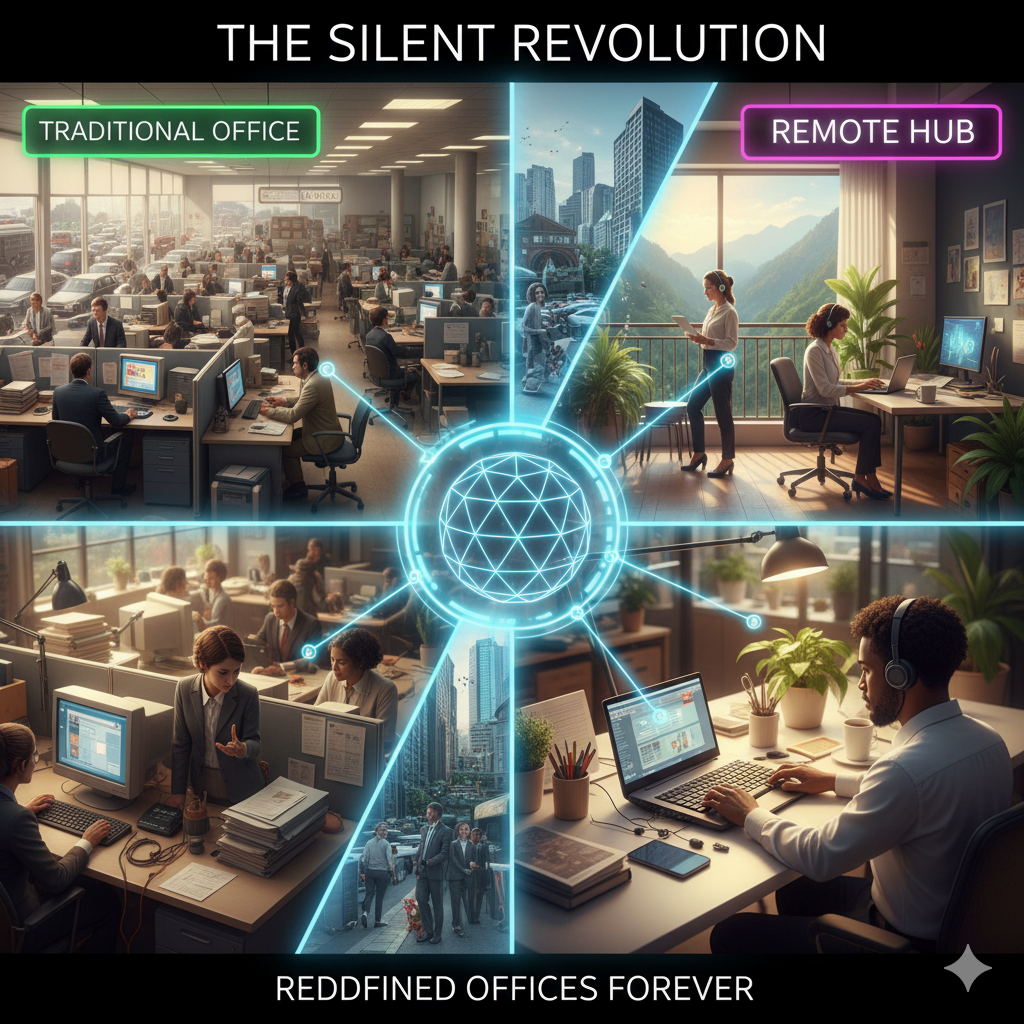
Detailed Comparison: The Traditional Office vs. The Remote Hub
The transition to remote work necessitates a change in how we measure success and structure our days. It’s a move from input-based metrics (hours spent at a desk) to output-based metrics (deliverables completed). The comparison below highlights the fundamental shift in operational philosophy.
| Feature | Traditional Office Model | Modern Remote Work Model (The Hub) |
| Philosophy | Presenteeism, Centralization, Fixed Hours | Trust, Flexibility, Asynchronous Focus |
| Communication Style | Spontaneous (walk-overs), In-person meetings | Intentional (scheduled calls), Asynchronous written updates |
| Measurement of Success | Time spent at desk, Visibility, Office hours | Defined deliverables, Key performance indicators (KPIs), Outcomes |
| Talent Pool | Geographically restricted (within commuting distance) | Global, unlimited by location |
| Real Estate Cost | High Fixed Cost (Rent, Utilities, Maintenance) | Low/Variable Cost (Home stipends, occasional coworking space) |
| Commute Time | A mandatory, unproductive drain on time and energy | Zero, converted into personal time, rest, or focused work |
The “Remote Hub” model is about creating a deliberate, documented, and decentralized approach to work. It acknowledges that the office environment’s strengths (spontaneous interaction) can be recreated and optimized, while eliminating its biggest weaknesses (cost, rigidity, and the time waste of the commute). This focus on The Silent Revolution of Remote Work is a focus on efficiency and well-being.
Key Features and Benefits: The Dividends of Distributed Work
The advantages of a successful remote work model span three critical areas: organizational efficiency, employee well-being, and environmental impact. These aren’t minor perks; they are structural shifts that create a massive competitive advantage.
<h3>For the Business: Access, Cost, and Resilience</h3>
- Unlimited Global Talent Pool: By removing geographical constraints, companies can hire the best talent in the world, not just the best talent willing to live near HQ. This drastically improves the quality and diversity of the workforce.
- Dramatic Cost Reduction: Eliminating or downsizing massive corporate leases slashes overhead. Savings on utilities, office supplies, and subsidized amenities can be redirected to research, development, or higher employee compensation.
- Built-in Business Continuity: A distributed workforce is inherently resilient. Local disruptions (weather, power outages, local emergencies) no longer halt company operations because the work is not tied to a single physical point.
<h3>For the Employee: Flexibility, Autonomy, and Well-being</h3>
- The Gift of Time: Eliminating the average 60-90 minutes of daily commuting time gifts employees with several hours per week for family, fitness, hobbies, or simply more sleep.
- Work-Life Integration: Remote work allows for work-life integration, where employees can manage personal errands, appointments, and family needs without sacrificing professional commitments. This is the true meaning of flexibility.
- Increased Autonomy and Focus: Employees gain control over their work environment—lighting, temperature, noise level—and their schedule. This enables them to structure their day around their peak productivity hours (chronotypes), leading to deeper, more focused work (Flow State).
<h3>The Environmental and Societal Impact</h3>
The shift to remote work has tangible benefits for the planet and local communities:
- Reduced Carbon Footprint: Fewer cars on the road means significantly lower CO2 emissions from daily commuting, contributing directly to climate goals.
- Decentralized Economic Growth: Money previously spent in dense, expensive metropolitan hubs now flows into suburbs and smaller towns, decentralizing economic activity and revitalizing local communities. This is a powerful, silent social shift driven by remote work.
Pros and Cons: Weighing the New Professional Equation
While the shift to remote work has been overwhelmingly positive for many, it is not without its challenges. A responsible assessment requires acknowledging the trade-offs involved in leaving the traditional office behind.
| Aspect | Pros (The Remote Advantage) | Cons (The Remote Challenge) |
| Productivity | Deep focus time, tailored workspace, output-driven metrics. | Over-working/Burnout (blurring of work/life boundaries), difficulty in disconnecting. |
| Talent & Hiring | Global talent pool, increased diversity, higher employee retention. | Challenges in fostering company culture and team cohesion across time zones. |
| Costs | Significant reduction in fixed real estate and operational expenses. | Increased cost for home office setup, potential complexity in state/international tax and labor law compliance. |
| Communication | Intentional, documented, searchable communication (via Slack/Teams). | Reduced spontaneous creativity, potential for social isolation and loneliness, “Zoom fatigue.” |
| Inclusivity | Better accessibility for people with disabilities or chronic health issues. | Unequal access to necessary technology or suitable home workspace (digital divide). |
The key to navigating the “Cons” is intentional management. The problems associated with remote work—like burnout and isolation—are largely solvable through conscious policy design, investing in digital social interaction, and setting clear boundaries between work time and personal time.
Use Cases: Who is Best Suited for the Remote Revolution
Remote work is not a one-size-fits-all solution, but its applications are incredibly broad, covering nearly all knowledge work sectors. The most successful implementations share a common thread: their work outputs can be digitized and shared efficiently.
<h3>Ideal Candidates for Full-Time Remote Work</h3>
- Software Developers & Engineers: Work is inherently digital, trackable, and deliverables (code commits) are perfectly suited to asynchronous workflows.
- Writers, Editors, & Content Marketers: Require long periods of deep focus with minimal distraction; deliverables (articles, reports) are entirely digital.
- Data Scientists & Analysts: Work primarily with large datasets and specialized software, needing powerful computing and minimal interruption.
- Customer Support & Service Roles: Can handle inquiries via phone, chat, and email from anywhere, often benefiting from the flexibility to cover global time zones.
<h3>Roles Suited for Hybrid or Flexible Remote Work</h3>
- Project Managers & Team Leads: Need some in-person time for complex brainstorming, kickoff meetings, and team building, but can manage daily execution remotely.
- Sales Professionals: Can manage pipeline and administrative tasks remotely but require occasional travel for client meetings and relationship building.
- Creative Professionals (Designers, Filmmakers): Benefit from focused remote work for execution, but often need collaborative, in-person sessions for initial concepting and feedback.
The shift toward remote work means that the default position for any knowledge-based role should now be remote or flexible, with the burden of proof falling on the organization to justify mandatory office attendance. This is the core belief driving the longevity of The Silent Revolution of Remote Work.
Frequently Asked Questions (FAQs) about The Future of Remote Work
<h3>Q1: How Can Managers Effectively Measure Productivity in a Remote Work Environment?</h3>
A: Effective remote work management shifts focus from hours (input) to outcomes and deliverables (output). Managers should set clear, quantifiable Key Performance Indicators (KPIs), utilize project management software for visibility, and hold regular 1:1 meetings focused on roadblocks, not surveillance. Trust, not tracking, is the foundation.
<h3>Q2: What is the Biggest Challenge to Maintaining Company Culture with a Remote Workforce?</h3>
A: The biggest challenge is replicating the spontaneous, casual interactions that build social capital. This requires intentional effort: mandatory “fun” breaks, non-work-related chat channels, virtual coffee dates, and planned in-person “team retreats” (off-sites) focused on strategic planning and social bonding, rather than daily office work.
<h3>Q3: How Can Remote Workers Avoid Burnout and Establish Healthy Work-Life Boundaries?</h3>
A: Remote workers must be disciplined about setting firm boundaries. This means having a dedicated workspace, logging off at a set time (and closing the laptop), and using the time saved from the commute to invest in self-care, exercise, or hobbies. Companies must also lead by example, respecting “Focus Time” and minimizing after-hours communication.
<h3>Q4: Does Remote Work Disadvantage Entry-Level Employees Who Need Mentorship?</h3>
A: This is a legitimate concern. Mentorship is crucial for early career development. Successful remote organizations must establish formal mentorship programs, utilize dedicated video-sharing for “shadowing,” and implement structured check-ins that encourage vulnerability and knowledge transfer, replicating the “tap on the shoulder” moments digitally.
<h3>Q5: Is Hybrid Work the Most Sustainable Model for the Future of Remote Work?</h3>
A: The hybrid work model—a mix of in-office and remote days—is often seen as a practical compromise. However, it only succeeds when implemented thoughtfully (e.g., set days for in-office attendance to ensure everyone is there simultaneously). If done poorly, it risks creating a “two-tier” culture where remote workers are penalized for not being physically present, negating the key benefits of remote work.
Conclusion: Summary and Recommendation for a Thriving Future
The Silent Revolution of Remote Work is here to stay. It is not merely a temporary trend but a permanent, structural shift enabled by technology and championed by a workforce demanding greater autonomy and flexibility. We have established that the benefits—global talent access, cost savings, environmental impact reduction, and profound improvements in employee work-life balance—far outweigh the challenges when the transition is managed with intention and trust.
Our recommendation is clear: organizations must transition their management philosophy from presenteeism to performance-based trust. Successful long-term strategy involves investing heavily in asynchronous communication tools, formalized digital social bonding, and robust training for managers on leading distributed teams. The future office should be viewed as a tool for collaboration and culture, not a compulsory destination for daily labor.
Final Verdict: The New Standard of Professional Life
The verdict is in: Remote work is not a perk; it is a competitive standard.
For organizations seeking to thrive in the 21st century, the ability to successfully recruit and retain top talent through flexible work arrangements is non-negotiable. The companies that will lead the next decade are those that master the art of asynchronous collaboration, decentralize their thinking, and trust their people to deliver results regardless of location. The rigid, hierarchical, five-day-a-week office model has been permanently redefined. The Silent Revolution of Remote Work is complete, and the decentralized future of work is now simply, the future.